
Seattle sees sharp decline in commute times due to remote work, decreased transit use
The rise of remote work and fewer people using public transit has lead to Seattle experiencing one of the nation's largest declines in commute times.


Seattle saw one of the nation's sharpest decline in commute times due to the rise of remote work. (Photo: Julia Dallas, MyNorthwest)
(Photo: Julia Dallas, MyNorthwest)
Seattle is notorious for traffic nightmares, but according to the latest Census Bureau data, commuters are finally seeing some congestion relief. Largely thanks to the proliferation of remote work, the average one-way commute for Seattleites dropped by 2 and a half minutes between 2019 and 2024.
Commute times were reduced from 28 minutes and 24 seconds to 25 minutes and 52 seconds even though the number of employed residents in the city went up by 15,000. As Gene Balk of The Seattle Times notes, that may not sound like much, but it adds up to over 20 hours of a commuter’s time back over the course of a year if they have a five-day work week.
Seattle roads clear as offices remain empty
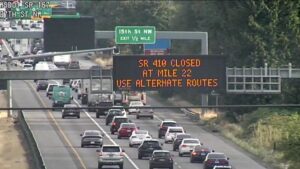
If there was one small silver lining brought about COVID, it was the reduction in travel times. Roughly one-quarter of Seattle’s employed residents work from home, which has opened up the roads during peak commute times.
36 of the nation’s 50 biggest cities experienced some decline in commute times, but Seattle’s large drop still appears to be an outlier. The average one-way trip in the United States was 27 minutes and 12 seconds, which was only down 24 seconds from before the pandemic. In fact, the Emerald City saw the third-largest drop in the country behind only San Jose and Oakland, California.
Seattle workers have stayed at home while most of the rest of the country has gotten back into the office.
Seattle area transit expands, but fewer people are using it
Another major factor for the decrease in average commute times is what Balk refers to as the “transit penalty.” Commuters who use transit, not surprisingly, take much longer to get to work than those who drive. Someone driving solo got to work on average in 26 and a half minutes in 2024, which was dwarfed by the whopping 49 and half minutes it took for a transit rider.
Because so many people in Seattle used transit, this lead to a much sharper decline in the city’s average commute times once many of those workers switched to remote work. In 2019, one-quarter of Seattle residents used public transit to get to work. However, by 2024 that number dropped to 15%.
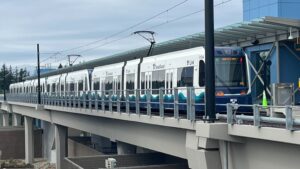
In a small bit of irony, Sound Transit has gone to painstaking efforts to coax commuters into using public transit with projects like light rail expansion that aren’t on time and over budget, and yet fewer people are using it.
Related
 Rantz: Seattle's war on cars squeezed 20,000 drivers into one Denny Way lane to save the 'late 8'
 Rantz: Sound Transit needs four years to install a turnstile, a device New York figured out in 1904. And it will still fail.
 Stuck in traffic? Seattle ranks 10th nationally for traffic delays, fueling debate over congestion pricing
 A year after fencing off pothole money for the World Cup, Seattle’s council keeps a 29% cut in play
 Everett’s bus merger will double its transit sales tax, even as voters complain about high cost of living
 Pierce County ferry fares rise again in January. What do riders get in return?

Comments
2 Comments
I was being courted for a job in Seattle and I turned it down. They even went so far as to point out that I would not have to deal with traffic because the train has a station under the building. NO, I freaking do not and WILL NOT give my talent to the likes of Seattle. Until the People of Seattle ACTUALLY come back to sanity, there is NOTHING they have that I want. I get everything AND MORE from Bellevue and Lynnwood. These cities are safe and sane.
one way to reduce commute times is to (i) drive busineses out, (ii) have massive office vacancies (iii) look reduced commute time...the seattle method