
Jim Walsh: Five Washington Supreme Court seats are on the 2026 ballot. Voters who skip them are handing the court to activists.
Five Washington Supreme Court seats are on the 2026 ballot. Here's how to cut through the confusion, ask the right questions, and vote for judges.

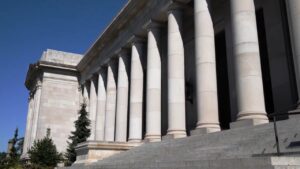
The Washington State Supreme Court ruled 6-3 that Initiative 2066, the voter-approved natural gas protection measure, is unconstitutional in its entirety. (Photo courtesy of Washington Supreme Court)
(Photo courtesy of Washington Supreme Court)
In Washington, we elect judges. Local municipal positions, state trial and appeals courts, the State Supreme Court—all Washington judges face the voters. Local and trial court judges serve four-year terms; appeals court and State Supreme Court judges serve six-year terms.
Many people in Washington believe that the governor appoints state judges, just as the president appoints federal judges. This confusion is understandable. The governor can appoint judges on an interim basis when sitting judges die or retire. These temporary appointees serve until the next general election, when they must be elected to stay on the bench.
In recent years, it’s become standard practice that state judges retire midway through their last term, so that the governor can appoint their replacement, who then runs for election as the incumbent judge. And usually wins, sometimes unopposed.
This year, things—especially with the State Supreme Court—will be different.
Why the 2026 Washington Supreme Court race is unlike anything voters have seen
There are nine judges on the Washington State Supreme Court. Those positions are set up in staggered six-year terms, so three positions come up for election every two years. But two judges retired recently. So, we have five of the nine State Supreme Court positions (a majority) on the ballot this November. And there are solid challengers in each race.
Here’s the issue with judge races: They suffer from “undervotes”—that is, voters leave them blank. And that tends to favor incumbent judges. When we ask voters why they leave judge races blank, the common answer is: “I don’t know enough about the candidates to make an informed decision.”
Again, this is understandable. Judge elections are different than other elections. In Washington, judge candidates are limited in what they can say when they’re campaigning. They can talk in general terms about their approach to the law and how they would organize their offices and staffs. But they can’t talk about how they would rule in a particular case or situation.
State law doesn’t control this. The restrictions about what judge candidates can or cannot say are controlled by the Washington Code of Judicial Conduct. This is a set of bureaucratic rules created and maintained by lawyers and judges. Judge candidates follow it, so this Code (known as “CJC”) is worth knowing.
The rule book that keeps judge candidates from telling you how they’ll vote
The CJC is made up of chapters called “Canons.” Canon 4 deals with judicial campaign issues. It has a long title: “A Judge or Candidate for Judicial Office Shall Not Engage in Political or Campaign Activity that is Inconsistent with the Independence, Integrity, or Impartiality of the Judiciary.” And it includes this statement:
“Even when subject to public election, a judge plays a role different from that of a legislator or executive branch official. Rather than making decisions based upon the expressed views or preferences of the electorate, a judge makes decisions based upon the law and the facts of every case. Therefore, in furtherance of this interest, judges and judicial candidates must, to the greatest extent possible, be free and appear to be free from political influence and political pressure.”
The first Rule in Canon 4 is most relevant to why judge candidates say so little. It says that a judge or a judicial candidate shall not (among other things):
- publicly self-identify as a member or a candidate of a political organization;
- personally solicit or accept campaign contributions;
- knowingly, or with reckless disregard for the truth, make any false or misleading statement;
- make any statement that would reasonably be expected to affect the outcome or impair the fairness of a matter pending or impending in any court; or
- in connection with cases, controversies, or issues that are likely to come before the court, make pledges, promises, or commitments that are inconsistent with the impartial performance of the adjudicative duties of judicial office.
The last two items are the ones that make it hard to know how a judge candidate might vote, if elected. The CJC goes on to state:
“The making of a pledge, promise, or commitment is not dependent on, or limited to, the use of any specific words or phrases; instead, the totality of the statement must be examined to determine if a reasonable person would believe that the candidate for judicial office has specifically undertaken to reach a particular result. Pledges, promises, or commitments must be contrasted with statements or announcements of personal views on legal, political, or other issues, which are not prohibited. When making such statements, a judge should acknowledge the overarching judicial obligation to apply and uphold the law, without regard to their personal views.”
What judge candidates are actually allowed to do on the campaign trail
While the CJC limits what judge candidates can say, it also says what they can do when campaigning. This includes:
- form a campaign committee to solicit funds, pay for advertisements and organize activities;
- review and approve the content of all campaign statements and materials produced by the candidate or judicial candidate’s campaign committee;
- wear robes in campaign literature if they are or have been a judge;
- appear at public events;
- answer questionnaires from people or organizations;
- group themselves into slates or other alliances to conduct their campaigns more effectively.
Voters can and should ask judge candidates about their “personal views on legal, political or other issues.” Judge candidates can’t hide behind the CJC and refuse to answer—though some will try to do that. It’s fair to ask a judge candidate at public forum or in a questionnaire what are his or her philosophies of law, public policy (including state tax policy), law enforcement, etc. If a candidate can’t answer such questions, he or she shouldn’t be on the bench.
The questions you should demand every judge candidate answer
Asking these questions doesn’t just help you. It helps every Washington voter who doesn’t know enough about the candidates to make an informed decision.
Finally, if you find a judge candidate violating CJC Canon 4, you have two ways to respond. If that candidate is already a judge, contact the Commission on Judicial Conduct. If the candidate is an attorney but not yet a judge, contact the Washington State Bar Association, Office of Disciplinary Counsel.
Jim Walsh is a Republican state representative from Aberdeen who serves as chairman of the Washington State Republican Party, where he has focused on rebuilding party infrastructure, candidate recruitment, and grassroots engagement.
Follow Seattle Red on-air at 770 AM, on the Seattle Red app, and streaming audio and video on SeattleRed.com.
Related
 Jim Walsh: Washington Supreme Court slaps down Ferguson's attempt to let unelected commission fire your sheriff
 Jim Walsh: Discovery of abandoned ballots in Renton must spark election security concerns
 Jim Walsh says hundreds of undelivered King County ballots were dumped near a Renton strip mall: Jason Rantz
 Cargill: Washington’s $4 billion budget gap proves Olympia has a spending problem
 Chris Cargill: First report on Idaho ed choice tax credit shows program a monumental success
 Dave Larson: Washington needs to reform judicial election process
Comments
2 Comments
Sadly, I imagine WA is bleeding active conservative voters like myself, making it all that much more difficult for those left behind. My wife and I are now fighting a similar but far more optimistic battle in Idaho.
Update: Sadly, a wave of RINOs have made significant inroads. Evidently vast amounts of corporate and out of state money were in play.
Thank you Mr. Walsh!!
I very much appreciate this article!
Now I know what I can ask of the judges/lawyers seeking to be on the WSSC!!
Sincerely, now I'm in the know!!!