
Pete Serrano blasts Washington Democrats for putting ICE agents in marked cars
Federal prosecutor Pete Serrano says Washington's refusal to issue confidential plates to ICE agents puts officers and the public at risk as DOJ sues the state.

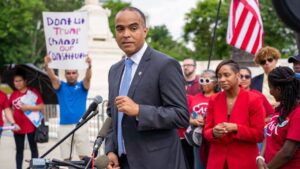
First Assistant U.S. Attorney for the Eastern District of Washington Pete Serrano says Washington's refusal to issue confidential license plates to federal agents puts officers and the public at risk. (Photo by Jamie Kelter Davis/Getty Images)
(Photo by Jamie Kelter Davis/Getty Images)
The U.S. Department of Justice last week filed lawsuits against Washington, Oregon, Maine, and Massachusetts for refusing to issue confidential license plates to federal law enforcement agents, a policy federal officials say endangers ICE officers and the public.
The four states all issue undercover plates to their own state and local agencies while denying them to federal applicants, particularly those handling immigration enforcement. The DOJ argues the practice violates the Supremacy Clause and is asking judges to invalidate it. The complaint follows a series of letters in which the states declined to reverse course.
First Assistant U.S. Attorney for the Eastern District of Washington Pete Serrano is blasting Democrats making these unconstitutional moves.
What confidential plates do
Federal agents conducting surveillance, transporting detainees, or running long-term investigations need vehicles that don’t immediately announce themselves. It’s the entire reason the program exists, and Washington runs the same program for its own officers.
“What it does is allow our folks to roll around, and when I say our folks, I mean federal law enforcement agents, to roll around in cars that look the same as yours and mine with license plates,” Serrano explained on The Jason Rantz Show on Seattle Red 770 AM. “Folks have asked me, well, why not just get an out of state license plate? Imagine this. Your neighbor is someone who’s selling drugs, committing crime, and you see a Montana plate out on a Tuesday and a Wednesday and a Thursday. Eventually, you’re going to call the police and say, hey, someone with no license plate, or a car that shows that it’s clearly a government vehicle, has been sitting outside my house for 72 hours. Mr. Police Officer, what’s happening here? Can you deal with this now? All of a sudden, you have this operation that’s at risk.”
The point is that drug dealers and other violent offenders under surveillance generally don’t want to be caught. Flag the surveillance and the operation collapses. A confidential plate keeps agents in the car looking like every other neighbor on the block.
A coordinated state strategy
Serrano said the license plate denial is part of a pattern. Portland just banned face coverings for federal officers, both Washington and Oregon sit on the DOJ’s sanctuary jurisdictions list, and California has its own running fights with federal immigration enforcement. The states aren’t pretending these moves are unrelated.
“There’s no question that it’s a coordinated effort, and it’s really frustrating. I’ve not had the chance to speak with the governor or the attorney general on this issue, but I do know my counterpart over in Seattle, Neil Floyd, has. Where can we meet in the middle on these issues? Where can we talk about these types of immigration issues in a way that’s better for the public, safer for the public? And the answer is, well, that would force us to violate the Keep Washington Working Act. We’re not asking you to do that. We’re just asking you to coordinate with us and work with us in a way that’s good for the public,” Serrano said.
The Washington State Department of Licensing declined to comment when MyNorthwest reported on the federal complaint. Massachusetts Governor Maura Healey’s office defended that state’s denial by arguing ICE was engaged in civil rather than criminal enforcement, even though Massachusetts continues issuing the plates to its own civil enforcement agencies.
Where this is headed
Serrano said the office’s posture doesn’t change whether or not the state comes to the table.
“My office, and I’m going to speak for [U.S. Attorney for Western Washington] Neil [Floyd], ultimately, we’re here to uphold the rule of law. When you break the law, you’ll be prosecuted. When the state doesn’t want to work to provide a safer environment, whether it’s through confidential license plates or some other shared activities, we, the United States Department of Justice, will do what we have to to provide a safe environment, not only for federal law enforcement agents, but for the people of Washington. If that means more lawsuits have to come, so be it. I’d prefer it not to be that way. I think we’d all prefer it not to be that way,” he said.
The same federal court that just convicted three Spokane ICE protesters will now decide whether Washington’s plate denial survives.
Listen to The Jason Rantz Show on weekday afternoons from 3 p.m. – 7 p.m. on Seattle Red on 770 AM (HD Radio 97.3 FM HD-Channel 3). Subscribe to the podcast here. Follow Jason Rantz on X, Instagram, YouTube, and Facebook.
Related
 'There really is a crisis': Foster couple punished for their faith beats Washington state in court
 Seattle ranks among most expensive World Cup cities for Airbnbs, study finds
 Meyer: Democrats said 'nobody is above the law.' Now the DOJ is investigating E. Jean Carroll.
 Rep. Matt Marshall warns I-638 will fail in court like I-2066, I-976 and I-1366 on a $150,000 budget
 Appeals court ruling could reopen the door for Washington residents who qualified for gun rights before the 2023 crackdown
 A state lawmaker is considering a recall against Attorney General Nick Brown
Comments
1 Comments
ICE owns undercover cars that are avalible in our state same with CBP. Conservative love to pound the table for states rights when it's things they disagree with but when it's something they believe in and other states make it hard its obstructionist. If Ice agents want to do their job show up in their marked cars or drive one of their already registered uncover cars from a location that already exists