
Cliff Mass: Washington reservoirs are full months early as drought panic fades — and the media has nothing to say
Washington's reservoirs are full months ahead of schedule. UW's Cliff Mass documented it. The Seattle Times and KING 5? Nowhere to be found.
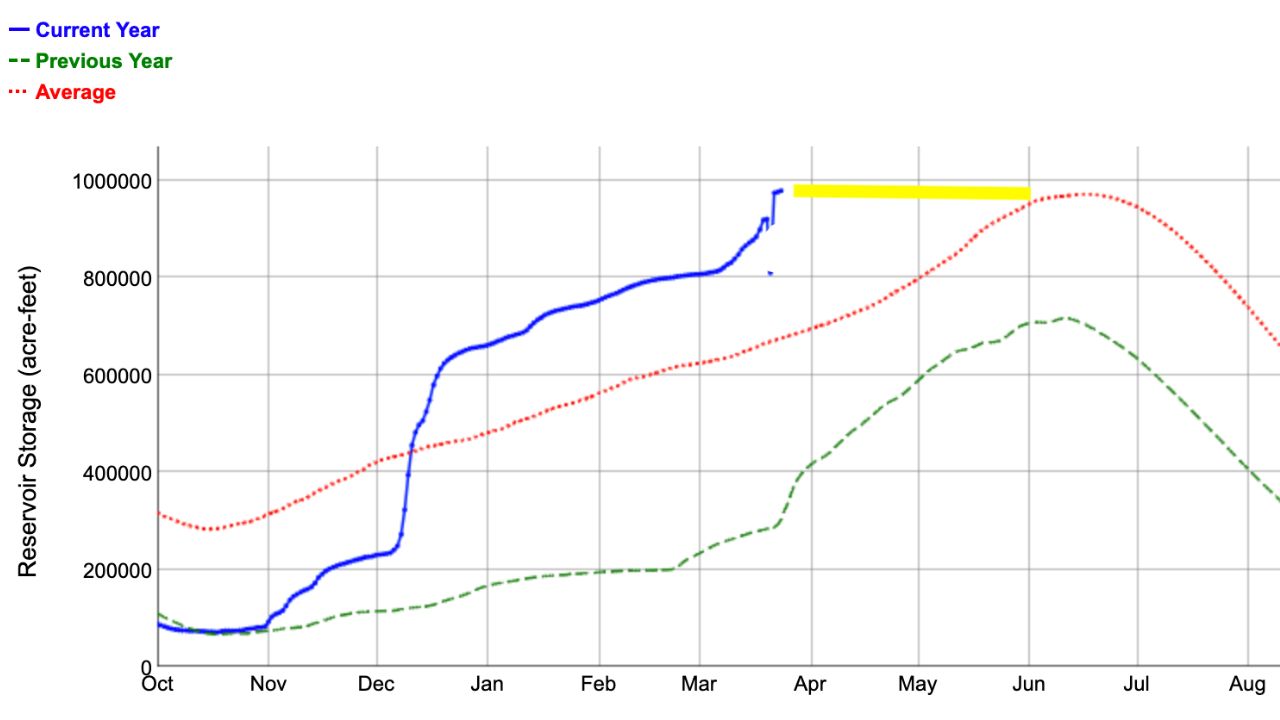
Line chart showing Washington state Yakima reservoir storage reaching full capacity in March 2026, months ahead of the historical June average and last year's levels. (Cliff Mass)
(Cliff Mass)
The Seattle Times warned you about water shortages. KING 5 picked it up. The Spokesman-Review dutifully followed. Low snowpack meant drought was coming for Washington, they said, and the climate implications were supposedly dire. Now the data is in, the reservoirs are full months ahead of schedule, and the same newsrooms that spent weeks alarming the public have had remarkably little to say about it.
University of Washington atmospheric sciences professor Cliff Mass documented Washington’s actual water picture in a post published March 25 on his widely-read weather blog, and the reality looks nothing like the crisis narrative local media had been running.
The Yakima chain of reservoirs, which typically doesn’t reach capacity until mid-June, is already full. Seattle’s municipal reservoirs exceeded their normal June maximum levels so significantly that managers had to release water to preserve flood control capacity. Spada Lake, the massive storage facility serving Everett, has hit full as well. Streamflow forecasts from the Northwest River Forecast Center show most regional rivers tracking at or near 100 percent of normal heading into midsummer.
Yakima chain of reservoirs hits capacity three months ahead of schedule
The outlets warning you about drought ignored every word of it.
“That’s being ignored, but it’s actually quite important that the reservoirs are full. In fact, they’re more than full, some of them way, some of the way ahead of normal. And the crucial reservoirs, the Yakima chain of reservoirs, which now are basically full, which they normally aren’t, till mid June. So we’re way ahead of time, and so we didn’t normally snow pack melt contributes to this, especially the next few months. We don’t need snow pack melt until go up this time, folks, because we had so much precipitation and it’s not stopping. So these reservoirs are just all the way up to the brim right now. So we don’t need the snow pack melt, and there’s going to be continuous. There’ll be rain between now and then, so we’ll be able to keep it full. So there’s no problem, but they want to make a problem where none exists.” Mass explained on The Jason Rantz Show on Seattle Red 770 AM.
The distinction he draws is important. The media’s drought framing rested almost entirely on the snowpack argument. Less snowpack, the logic went, means less water feeding into reservoirs as spring turns to summer. What that framing ignored is that an exceptionally wet winter and early spring filled the reservoirs through direct precipitation, bypassing the snowmelt step entirely. The snowpack-to-drought equation requires that snowmelt actually be needed to fill the reservoirs. This year, it wasn’t.
Seattle Times warned of water shortages. The data went the other way.
When asked during the same interview what the outlook for summer water supply actually looks like, Mass was equally direct.
“Well, there’s no reason to expect that if the resin normally we depend on a little bit of snow melt to fill the reservoirs, but they are full, and there’s no reason that the precipitation is going to stop now, so we’ll be able to keep them full. So there’s absolutely no reason to be worried we will have plenty of water for this summer. There will be plenty of water for our region. And by the way, looking at the forecast models for the next few weeks, there’s more precipitation coming. So there’s really no reason for concern.” Mass explained.
The Seattle Times was specifically told its snowpack-drought framing was wrong. Asked why the paper continued making that case despite the data, Mass said: “I think they’re trying to bring a connection with climate change. Obviously. So the issue is that you have global warming, that means less snow pack. Well, that’s pretty robust over the long term, although we haven’t seen that much decline yet. So global warming makes it warmer, which means you have less snow pack. And so they want to connect less snow pack with something that has big implications for people, and that’s the wildfires. So I think that’s why they’re doing it. I think that’s pretty obvious.”
That is the operating playbook. Find the climate connection, find the alarming implication, run the story. The actual reservoir data is a complication the narrative doesn’t need.
Listen to The Jason Rantz Show on weekday afternoons from 3 p.m. – 7 p.m. on Seattle Red on 770 AM (HD Radio 97.3 FM HD-Channel 3). Subscribe to the podcast here. Follow Jason Rantz on X, Instagram, YouTube, and Facebook.
Related
 ‘Basically all wrong’: UW’s Cliff Mass blasts Seattle Times atmospheric river report
 Cliff Mass takes a shot at the Seattle Times Climate Lab over El Niño’s Washington coast Kelvin wave hype
 Cliff Mass says Seattle’s sunglasses-and-sweater season ends soon, and the weather goes downhill fast after this date
 UW scientist Cliff Mass shreds Seattle Times Skagit flood story, says it skipped the one dataset that mattered
 Southwest Washington jolted awake at 4 a.m. as magnitude 3.7 quake rattles LongviewUW weather guru Cliff Mass warns Western Washington the fall transition has started and next weekend brings the soaking
Comments
1 Comments
I wonder... If you listen very closely, can you hear black-bloc activists siphoning off the unexpected relief to maintain the narrative?