
WAGOP Chairman Jim Walsh: How to fight Bob Ferguson’s Washington income tax scheme
Washington Gov. Bob Ferguson’s proposed millionaire income tax faces major constitutional hurdles under Article VII and decades of state Supreme Court precedent.

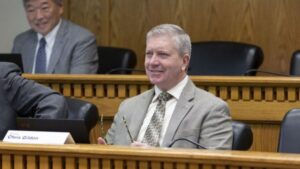
Bob Ferguson fills board seat amid legal recall threat. (Photo by Stephen Brashear, Getty Images and Washington State Legislature)
(Photo by Stephen Brashear, Getty Images and Washington State Legislature)
Washington Governor Bob Ferguson has proposed a new state income tax scheme that he feebly calls a “millionaire tax.” It would inflict a 9.9 percent tax on earned income above a certain threshold. This would come in addition to the state’s recently-passed “capital gains” tax on investment income.
Several analysts have called the current governor’s scheme “unconstitutional” and many people have asked whether Washington’s state constitution prohibits a state income tax. The proposed scheme is unconstitutional. But the state constitution does not prohibit all forms of state income tax—just poorly-structured ones.
What does the Washington State Constitution say about an income tax?
Article VII of the Washington State Constitution defines tax policy. This section is one of the things that distinguishes our state constitution from the federal version and those in many other states. Ours protects Washington residents from government overreach and has kept our state’s finances in better shape than states like California, Illinois and New York.
Article VII, Section 1, sets the standard for Washington tax policy clearly and powerfully:
All taxes shall be uniform upon the same class of property within the territorial limits of the authority levying the tax and shall be levied and collected for public purposes only. The word “property” as used herein shall mean and include everything, whether tangible or intangible, subject to ownership.
The key words here are, “All taxes shall be uniform…” This means flat.
Here’s what this means
In Washington, tax rates must be the same for all people on all categories of property—tangible (real estate, etc.) or intangible (income, etc.). The state can’t levy the same tax at one rate on Person A, but at a different rate on Person B.
Which is exactly what the current governor’s scheme tries to do. It claims to tax “millionaires” on their income but does not tax other Washingtonians on their income.
The key precedent on this topic is the 1933 Washington Supreme Court decision Culliton v. Chase, which has stood up to repeated challenges for more than 90 years. In that case, the State Supreme Court overturned a “progressive” state income tax scheme similar to the one the current governor proposes.
In Culliton, the Court concluded that “income is property.” Therefore, a graduated income tax is unconstitutional in Washington state because it does not tax all like property uniformly. Here’s the relevant excerpt:
…“property” is “everything, whether tangible or intangible, subject to ownership.” …There being no other classifications in our Constitution but real and personal property and intangible property, incomes necessarily fall within the category of intangible property. No more positive, precise, and compelling language could have been used. It needs no technical construction to tell what those words mean. The overwhelming weight of judicial authority is that “income” is property and a tax upon income is a tax upon property.
The current governor and his comrades on the Left are counting on the current State Supreme Court to engage in precisely the sort of “technical construction” that the earlier Court found unnecessary. And the current State Supreme Court may oblige them.
How the State Supreme Court could decide
It used “technical construction” and a heavy dose of specious logic in its 2023 decision Quinn v. State. In that opinion, the Court ruled that Washington’s new “capital gains” tax is an “excise” tax not a property tax—and therefore not subject to the constitution’s uniformity requirement:
This [capital gains] tax is wholly unlike the broad-based net income taxes we previously invalidated under Culliton. Those taxes applied to the taxpayer’s aggregate net income and were untethered to any specific taxable activity; rather, the taxable incident was the receipt of income itself. Here, the capital gains tax does not capture net income sources but instead narrowly applies to capital transactions resulting in realized gains. …In light of this holding, we decline to interpret article VII or to reconsider our decision in Culliton.
Two State Supreme Court Justices dissented from the majority’s opinion in Quinn, writing more coherently:
“Capital gains” are income. In Washington, income is property. A Washington “capital gains tax” is therefore a property tax.
The current governor’s state income tax scheme would fail even under the standards that the Court described in its rambling Quinn decision. Another left-wing tax proposal—expanding the state capital gains tax to unrealized profits—would also fail. So, the State Supreme Court would have to reject its own reasoning in Quinn to justify these new taxes.
Worse: The Court may tell the current governor that his income tax scheme must apply to everyone—and he’ll obey.
How will Washingtonians react?
What will common-sense Washingtonians do, if the current governor and his comrades on the Left push their schemes through Olympia? File lawsuits, of course. And we will probably need to file in federal court, since our state courts have become rubber stamps for illegal and unconstitutional actions.
Federal courts generally don’t like to consider state tax policy disputes. But the Culliton and Quinn cases suggest a strategy for moving the fight to federal court. That strategy focuses on the “equal protection” language in the U.S. Constitution and the lesser-known “dormant commerce” clause under its Article I, Section 8.
This “dormant commerce” clause prohibits certain state taxes “even when Congress has failed to legislate on the subject.” This is designed to prevent states from “retreating into economic isolation or jeopardizing the welfare of the Nation as a whole.”
Constitutional protections
In recent years, federal courts have developed a four-part test to determine whether a state tax violates the “dormant commerce” clause. This test requires a tax to be:
- “applied to an activity with a substantial nexus with the taxing State,”
- “fairly apportioned,”
- nondiscriminatory with respect to interstate commerce, and
- “fairly related to the services provided by the State.”
The current governor and his comrades on the Left in Olympia may not care about constitutional protections—or may be ignorant of them. But these constitutional protections still apply to every Washingtonian, regardless of the Olympia Left’s schemes and scams.
It’s up to all of us to make sure these protections are protected. And maintained.
Jim Walsh is a Republican state representative from Aberdeen who serves as chairman of the Washington State Republican Party, where he has focused on rebuilding party infrastructure, candidate recruitment, and grassroots engagement.
Related
 WA GOP slams Governor Bob Ferguson budget as smoke and mirrors on affordability
 Washington ranks 23rd nationally for stress due to rising mental health struggles: study
 Republican proposes overdose map for WA after 259% spike since 2016
 Rep. Baumgartner urges Gov. Ferguson to 'opt in' to new $1,700 federal education tax credit
 Rantz: Student loan debt wage garnishment isn’t cruelty, it’s accountability
 Cargill: Washington’s $4 billion budget gap proves Olympia has a spending problem
Comments
1 Comments
The narrative will be that we are only taxing the rich so that they pay 'their fair share" and We the Sheeple will buy it hook, line and sinker. How naive to think this is not the first step towards an income tax for everyone.