
Rantz: Why Bob Ferguson’s 9.9% income tax is unconstitutional in Washington state
Gov. Bob Ferguson signed SB 6346, a 9.9% income tax on millionaires. Here's why it violates the Washington Constitution — and why courts can't fix that.


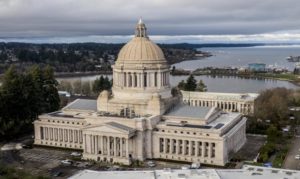
The Washington State Supreme Court ruled 6-3 that Initiative 2066, the voter-approved natural gas protection measure, is unconstitutional in its entirety. (Photo courtesy of Washington Supreme Court)
(Photo courtesy of Washington Supreme Court)
Washington Democrats have spent the better part of a century trying to impose a state income tax on residents, and they keep running into the same stubborn problem. The state constitution says they cannot do it. So rather than go through the exhausting process of actually convincing voters to change the constitution, they have decided to do something far more creative and devious: change what basic words mean.
But why, specifically, is a state income tax unconstitutional? It’s actually quite simple to understand.
Article VII, Section 1 of the Washington Constitution requires that all taxes on property be uniform across the same class. In 1933, the Washington Supreme Court ruled in Culliton v. Chase that income is property. That ruling made a graduated income tax unconstitutional on its face, because you cannot tax one person’s property at a steeper rate than your neighbor’s simply because they have more of it. A graduated income tax is a system where higher earners pay a higher percentage of their income in taxes than lower earners, rather than everyone paying the same flat rate.
That decision has survived for more than 90 years through ballot initiatives, legislative maneuvering, and repeated court challenges. What has changed recently is not the constitution. What has changed is the willingness of Washington’s Democratic majority and the current state Supreme Court to act as though it no longer applies.
The Culliton v. Chase ruling and why it blocks a Washington income tax
The facts behind Culliton v. Chase are almost embarrassingly simple, which is probably why the ruling has held up so long.
In 1932, Washington voters approved Initiative 69, which created a graduated income tax to help fund state government during the Great Depression. A group of taxpayers immediately challenged the law, arguing it violated the Washington Constitution’s requirement that property be taxed uniformly. The case reached the state Supreme Court in 1933, where the court struck down the tax by ruling that income is a form of property and therefore subject to the uniformity requirement, making a graduated income tax unconstitutional under the state’s own founding document.
Therefore, it is unconstitutional, and any income tax that is not flat across the entire board runs directly into the same constitutional wall.
This holding has been tested over and over again. Voters have rejected income tax initiatives at the Washington ballot box ten separate times across the decades. Courts have consistently reaffirmed the Culliton framework when pressed on it. The reason the case has survived is not that it is untouchable or sacred; it is that the constitutional text it relies on has never been amended. The words are still there. The logic still follows. The math has not changed.
How Democrats are redefining income to dodge the Washington Constitution’s uniformity clause
Here is the current text of Article VII, Section 1, as amended (Amendment 14, 1930): “The power of taxation shall never be suspended, surrendered or contracted away. All taxes shall be uniform upon the same class of property within the territorial limits of the authority levying the tax and shall be levied and collected for public purposes only. The word ‘property’ as used herein shall mean and include everything, whether tangible or intangible, subject to ownership.”
That last sentence is the one that does all the heavy lifting in the income tax debate. The constitution does not say property means land and buildings. It says property means everything subject to ownership — tangible or intangible. Your paycheck. Your capital gains. Your salary. All of it. Which is exactly why the Culliton court had no trouble concluding that income is property, and why that conclusion has been so difficult to dislodge in the 90-plus years since.
Faced with this obstacle, Washington Democrats have settled on an approach that conveniently avoids the messiness of actually amending the constitution. Their strategy is to legally decouple the concept of income from the concept of property. If a court can be persuaded that income is not property, or that certain kinds of income do not qualify as property, then the uniformity requirement stops applying, and a graduated income tax becomes perfectly constitutional without a single voter being asked about it.
This is less a legal argument than it is a semantic shell game. It has, however, found a receptive audience on the current Washington Supreme Court, which has shown a remarkable appetite for creative interpretation whenever the outcome conveniently aligns with progressive policy goals. The capital gains tax fight handed them the perfect opportunity to demonstrate that appetite, and they ran with it.
The capital gains pretzel that would make a contortionist wince
In 2021, the Democratic-controlled legislature passed a 7 percent tax on capital gains above $250,000. The federal government classifies capital gains as income. The Internal Revenue Service (IRS) taxes capital gains as income. Every state that levies a capital gains tax treats it as income. Washington Democrats, however, needed this particular tax to not be an income tax for reasons that should be obvious by now, so they labeled it an excise tax on the privilege of selling assets.
In 2023, the Washington Supreme Court, with what can only be described as admirable audacity, agreed.
The majority held that taxing the proceeds of a sale was a tax on the transaction itself rather than a tax on income or property. The dissenting justices found this reasoning somewhere between unpersuasive and absurd, and they said so in terms pointed enough to make the dissent worth reading on its own. What the federal government calls income, what the IRS processes as income, and what anyone outside the state capitol understands to be income had, in the majority’s telling, somehow transformed into something categorically different the moment it crossed the Cascades. If the IRS ever figures this out, Washington may have stumbled onto something.
What the SB 6346 income tax means for Washington taxpayers
The capital gains decision was never just about one tax on high earners. It was a proof of concept, and everyone in Olympia knows it.
If the court was willing to call capital gains an excise tax to sidestep Culliton, Democrats now have a working template. Tax other forms of income, attach a different label to the levy, and let sympathetic justices handle the constitutional heavy lifting in exchange for good press and a judicial appointment.
Washington residents have been protected from an income tax for more than 90 years by a constitution that has never been amended to allow one. That protection is being dismantled not through the process the constitution itself requires, not through honest persuasion of voters, but through a series of rulings that redefine ordinary words until the original meaning quietly disappears. The game is rigged, the referee is in on it, and the only people who seem alarmed are the ones who will eventually be writing the checks.
Listen to The Jason Rantz Show on weekday afternoons from 3 p.m. – 7 p.m. on Seattle Red on 770 AM (HD Radio 97.3 FM HD-Channel 3). Subscribe to the podcast here. Follow Jason Rantz on X, Instagram, YouTube, and Facebook.
Related
 Former Washington state lawmaker ditching state for Idaho: 'Peace out'
 Rantz: Ferguson to sign Washington income tax SB 6346 into law Monday, after deliberate delay strategy exposed
 Group launches lawsuit against Gov. Bob Ferguson's unconstitutional 9.9% income tax
 Rantz: Why Seattle is so liberal — and why nothing seems to change it
 Rantz: Lynnwood scrapped cameras that track car thieves, now wants speed cameras ticketing drivers at 2 a.m. outside empty schools
 Rantz: The Education Lab takes Gates and Ballmer money, then prints activist talking points on trans athletes as fact

Comments
3 Comments
Imagine the absolute GALL and contempt for liberty one must have to suggest that the right of citizens to exchange private goods and services is a privilege.
"Unconstitutional" is simply another word under the "U" heading in the dictionary when you're an Olympia, WA (D) legislator with a compliant state Supreme Court waiting to fulfill your every wish.
I think it's called "Marxism."