
Trump is finally forcing the daylight saving time vote Washington has been begging Congress for since 2019
The U.S. House votes next week on permanent daylight saving time, a move that could finally trigger Washington's stalled 2019 law after a seven-year wait.
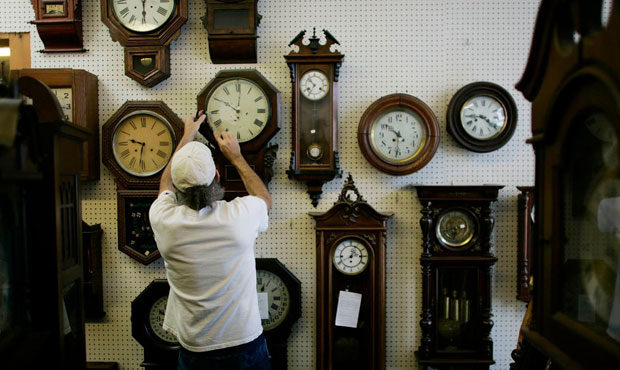
A clock reflects the twice-yearly time change that Washington voted to end in 2019, a switch now tied to a pending vote in the U.S. House. (Photo by Joe Raedle/Getty Images)
(Photo by Joe Raedle/Getty Images)
Washington voted to ditch the clock change seven years ago. Next week, the U.S. House will finally decide whether that vote meant anything.
The House is scheduled to vote next week on the Sunshine Protection Act, legislation that would make daylight saving time permanent across the country and end the twice-yearly ritual of resetting clocks. The measure cleared the House Energy and Commerce Committee 48-1 in May and lets individual states opt out. Supporters argue the twice-yearly switch disrupts sleep and drags down productivity. For Washington, a yes vote would deliver something the state has wanted since 2019.
Washington lawmakers passed their own permanent daylight saving time law that year, 90-6, and then-Gov. Jay Inslee signed it. Then nothing happened, because the state cannot act alone.
Washington’s seven-year wait
The Uniform Time Act does not let a state adopt permanent daylight saving time without approval from Congress, so Washington’s 2019 law has been frozen ever since. A state can move to permanent standard time on its own, the path Arizona and Hawaii took, but Washington chose daylight saving time and put its fate in congressional hands.
President Donald Trump is now the one pushing it over the line. He cheered the committee vote and vowed to work hard to get the bill signed.
“It’s time that people can stop worrying about the ‘Clock,’ not to mention all of the work and money that is spent on this ridiculous, twice yearly production,” Trump wrote on social media after the vote.
The bill was introduced by Rep. Vern Buchanan, a Florida Republican, where supporters say the extra evening light could boost tourism. Rep. Frank Pallone, the top Democrat on the committee, backed it as well, arguing it would improve safety and help his state’s tourism industry.
What it changes for the Pacific Northwest
In Washington, permanent daylight saving time would delay the December sunrise until close to 9 a.m.
British Columbia plans to stop changing its clocks in November 2026, moving to permanent daylight saving time on its own because Canada does not need congressional permission. When Washington falls back Nov. 1 and B.C. does not, Seattle and Vancouver will run an hour apart through the winter for the first time in decades.
The country has run this experiment before. It stayed on year-round daylight saving time during World War II, and President Richard Nixon revived it briefly during the 1973 oil crisis. The Senate has already shown it can pass this. It approved a nearly identical measure by unanimous consent in 2022, only to watch it die in the House. This time the House votes first. If it holds, Washington’s long-delayed law could finally take effect, and the state might fall back this November for the last time.
Follow Seattle Red on-air at 770 AM, on the Seattle Red app, and streaming audio and video on SeattleRed.com.
Related
 Two Washington renter protection plans that will raise your rent, expert warns
 KING 5's Sharon Yoo hypes Puget Sound ICE 'quota' arrests without saying who was arrested
 Spokane council to vote on ordinance forcing landlords to cool rentals to 80 degrees
 Everett wants $5 million for a new housing fund. Where will it go?
 Rantz Exclusive: Seattle police recruit pipeline drops to 51 as officer departures hit 94, pacing to exceed 2025 separations
 Rep. Matt Marshall warns I-638 will fail in court like I-2066, I-976 and I-1366 on a $150,000 budget
Comments
3 Comments
I wondered if the knee jerk TDS would make WA lawmakers suddenly decide they wanted to withdraw their vote to stop changing our clocks with the President supporting it.
I am vehemently against a permanent switch to DST. My job in industry/logistics and the jobs of many other people I know require early start times variably between 4 and 7 am. Very discouraging to think that the rest of my working life I'll have to be battling the early morning dark on the roads and difficulty getting to bed for a decent night's sleep for more of the year. I've come across studies/reports from medical professionals that say standard time aligns best with circadian rhythms and more favorable health overall. While there may be benefits and enjoyment in it for a lot of people, it will also be a detriment to many of the hardest working people in the state and the country. I love standard time, and wish that could be the permanent choice instead.
We can only hope. Permanent standard time would be much more in tune with our circadian rhythms.