
Flock Safety pushes back on the myths driving Washington’s camera bans
Flock Safety's legal chief takes apart the ICE, warrantless-access, and surveillance-state claims pushing Washington cities to rip out license plate cameras.

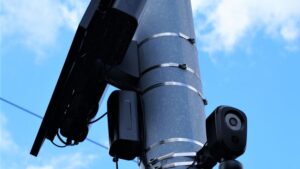
Renton is preparing to physically cover its Flock Safety automated license plate reader cameras as the City Council weighs ending the contract. (KIRO 7)
(KIRO 7)
The company behind the automatic license plate reader (ALPR) cameras that Washington cities keep ripping out says most of the case against the technology rests on claims that are simply not true.
Flock Safety has spent the past year as the villain in a string of city council votes across the Puget Sound, with Edmonds, Lynnwood, and Mountlake Terrace all walking away and others pausing their networks amid privacy fears. Much of that opposition leans on a handful of recurring assumptions about what the cameras do, who can see the data, and how the company operates.
Dan Haley, chief legal officer at Flock Safety, took those assumptions apart one at a time.
The ICE myth
The loudest argument against Flock is that the cameras quietly serve federal immigration enforcement. Haley says that connection does not exist, and that councils switching off cameras to spite ICE are aiming at the wrong target.
“We don’t have anything to do with immigration enforcement, and in each community that has Flock, the data is controlled. Access to the data is controlled by that community. Period. Full stop. We don’t sell it, we don’t share it, we don’t provide side or back door access to it. If a community wants to share data with federal law enforcement, they can opt to do that, and if they want to absolutely prohibit that, they can do that as well,” Haley said on The Jason Rantz Show on Seattle Red 770 AM.
He compared the protest gesture to changing shoes to send a message to Washington.
“I understand if that’s your politics, that’s your impulse, you want to do something, but it’s an ineffective gesture,” he said.
The warrantless-access myth
A second claim holds that federal agencies can reach into a Washington city’s network without a warrant or local sign-off. The fear grew after an October University of Washington report said federal agencies tapped Flock networks across the state thousands of times. Haley argued the system was built to expose that activity rather than hide it.
“It is set it and if you decide to share data, every single sharing of data is permanently logged in the system, and so the reason that communities are able to look back and say, oh, there was sharing that I didn’t intend to authorize, or that I did authorize, but now we’re in a different political moment, and so I want to reverse that. The reason that information is even available is because the system was engineered so that you can’t abuse it without creating a record of that abuse or misuse or mistaken use, or whatever it might be,” Haley noted.
Flock submitted a correction to the report’s authors, he added, though he said it rarely gets cited when the study comes up.
The surveillance-state myth
The biggest charge is that Flock is building a surveillance state. Haley said he took the job only after a long talk with the company’s CEO about privacy, and that the technology was designed around those concerns.
“I joined the company after a long conversation with the CEO about Fourth Amendment concerns. I have Fourth Amendment concerns, meaning right to privacy,” Haley said.
He pointed to the families left behind when councils kill the cameras, especially in high-crime neighborhoods where they cut crime fastest.
“These systems have no bias, they have no ability to have bias, and one would think that would be an attractive thing. It’s certainly an attractive thing to the people who live in those communities,” he said.
He had a final answer for the activists driving the bans.
“None of us wants to live in a surveillance state. Nobody working at Flock wants to live in a surveillance state,” Haley added.
Listen to The Jason Rantz Show on weekday afternoons from 3 p.m. – 7 p.m. on Seattle Red on 770 AM (HD Radio 97.3 FM HD-Channel 3). Subscribe to the podcast here. Follow Jason Rantz on X, Instagram, YouTube, and Facebook.
Related
 Why did city of Edmonds ditch cameras that find missing kids? Politics
 Washington's new tax forces insurance companies to bankroll abortion fund
 UW activists appear to fish for faculty to become plaintiffs in anti-Trump lawsuits
 Seattle schools were told to close empty buildings nearly 40 years ago, then shelved the audit when neighbors complained
 ‘Ratchet ass Tacoma’: New body cam shows what Krista Perez said about the city she was just elected to represent
 A state lawmaker is considering a recall against Attorney General Nick Brown
Comments
2 Comments
whatever you do don't out one near patty horse teeth murray. that would horrify anyone
“None of us wants to live in a surveillance state. Nobody working at Flock wants to live in a surveillance state,”
And yet, Flock exists entirely to surveil the public for the State. What would you call that?
Frankly, if we're going to have public surveillance, no government agency (state or federal) should have access to the footage without a warrant and being able to show RAS, at the very least.