
Rantz: King County quietly doubled the damage necessary to charge vandalism as a felony — and didn’t tell anyone
King County raised malicious mischief felony charge thresholds and quietly removed the offense from its expedited crimes list with no public announcement.

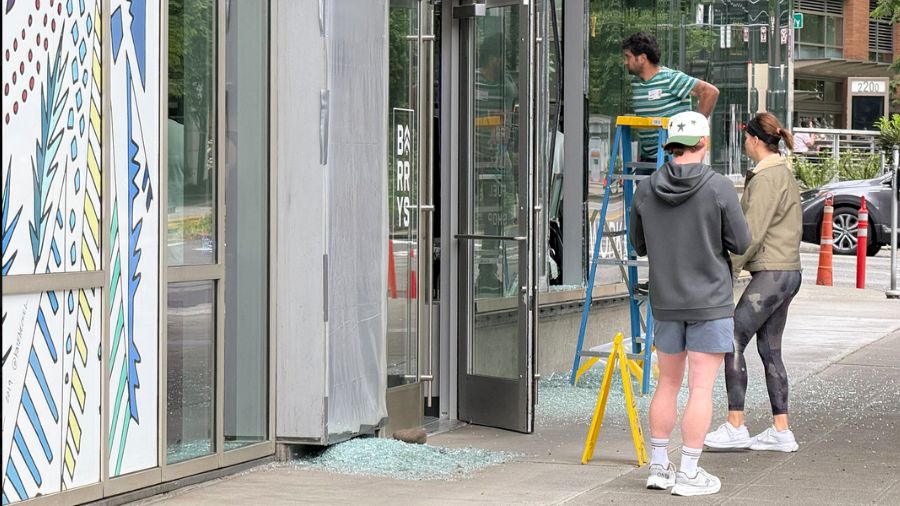
Police arrested a suspect early Saturday after he allegedly shattered the windows of several businesses with rocks. (Jason Rantz)
(Jason Rantz)
King County’s Prosecuting Attorney’s Office (KCPAO) quietly overhauled its malicious mischief prosecution standards last month, dramatically raising the bar for felony charges, stripping the offense from the county’s expedited crimes program, and requiring written professional estimates before prosecutors can charge property damage cases, with no public announcement attached. The KCPAO is framing the change as a consequences of not being properly funded at the county level.
The changes appear in the office’s April 2026 Filing and Disposition Standards (FADS), the internal rulebook governing how the office handles criminal charges. A Jason Rantz Show comparison of the 2024 and 2026 versions found four changes to how malicious mischief cases are charged; every one of them makes prosecution harder, and none make it more aggressive. Property crime has been at the center of Seattle’s public safety debate for years, with business owners and law enforcement leaders warning that letting vandalism go unanswered drives businesses out of neighborhoods. These new standards shift more of it into the misdemeanor column, no announcement required.
The Prosecuting Attorney’s Office confirmed the changes on the record.
Off the expedited crimes list
The 2024 standards listed malicious mischief among the offenses designated for the county’s expedited filing program, a process where crimes that legally qualify as felonies are filed in District Court as attempted Class C felonies to speed case resolution. The April 2026 version removes it from that list without explanation in the document itself.
KCPAO spokesman Casey McNerthney offered one when Seattle Red asked.
“Taking Malicious Mischief off the list of expedited offenses is not the same as saying King County prosecutors will no longer file or rush file those cases. The KCPAO still rush files malicious mischief cases within 72 hours (the rush-file window) when police refer those cases with sufficient evidence. Cases with $5,000 or more in damages are felony cases,” McNerthney explained.
“Felony malicious mischief referrals remain with our Violent Crimes Units, which are used to meet quick rush-file deadlines… The Expedited Crimes section of the previous filing standards referenced a specific program where crimes that legally qualify as a felony are filed as attempts of Class C felonies to potentially expedite a resolution, which has similar or longer sentencing ranges. That is an entirely different thing than what cases the PAO reviews and files quickly or expeditiously, which still happens.”
But in practical terms, cases in the $2,000 to $5,000 damage range, which previously entered the expedited program and were treated as felony-level matters in District Court, now go straight to misdemeanor referral instead.
Thresholds more than double
The revised standards also restructure how damage amounts determine charge severity. The 2024 standards set a direct misdemeanor referral for property damage below $2,000, expedited felony filing for damage between $2,000 and $7,500, and Superior Court felony filing above that. The April 2026 version moves the misdemeanor floor to $5,000 and requires damages above $10,000 before a first-degree charge applies.
McNerthney cited both inflation and increased caseload complexity for the move.
“In nearly 20 years, state lawmakers have not updated the felony Malicious Mischief statute to adjust for inflation,” he explained.
“The monetary requirements for first- or second-degree malicious mischief were set by the legislature in 2009 ($750 for second-degree and $5,000 for first-degree, though our previous filing standards had our second-degree level adjusted for inflation at $2,000).
“Back in 2009, the median household income in Seattle was $60,843. Now it’s $131,906. That change paints a clearer picture of how things locally are increasing compared to simply looking at a nationwide inflation calculator, which shows $5,000 inflating to roughly $7,700 between 2009 and 2026,” he added.
Cases are becoming more complex
“Malicious Mischief cases are not what they were in 2009. In 2009, most jurisdictions here didn’t have body-worn cameras. Now multiple officers responding to calls have body-worn and dash-camera video that gets submitted with a case and each need to be reviewed to avoid surprises. Reports are also longer and more complex. And jurors’ expectations of evidence are higher. These are all ways of saying: while you may see similar caseload numbers, the complexity and time spent on the cases are much different — all while public defenders here have significantly lower caseloads and significantly higher staffing levels.”
McNerthney also stressed that the standards function as guidelines, not hard rules. He says the office individually reviews cases, which will include a suspect’s “history and the current offense,” before filing decisions are review by senior staff.
“If police are notified of our decision and don’t agree, or have more information to share, we welcome that additional input — they can (and do) call and explain why prosecutors should reconsider. Those are actual conversations when they call. The filing standards are guidelines, not requirements. There are cases filed that don’t meet those thresholds but have either input from police or prosecutors about why filing this particular case is important,” he explained.
New evidentiary requirements for victims
The April 2026 revision adds explicit language ruling out rough estimates from victims as sufficient to establish damage amounts for charging. Written professional estimates or repair receipts are required, language that appears in the written standards for the first time.
McNerthney told The Jason Rantz Show on Seattle Red that courts were already requiring this before it was written down.
“This additional language does not add a new evidentiary requirement; it was put into writing to reflect the evidence that courts are already routinely requiring, and issues that are routinely raised by defense. We know from experience that courts often will not accept Malicious Mischief filings without a written damage estimate to show that the felony legal requirements are met. In an assault case — even in a case that looks awful — you can’t go to court and say ‘I think there’s a broken bone’ and have judges consistently agree that you meet the legal standards for filing a felony level assault. You have to show a clear medical record outlining the actual damage done. It’s the same with malicious mischief and damage estimates — even cases that you may think would be obviously over the threshold are not guaranteed to be accepted by the court without a written estimate to show the damage meets the felony legal requirement,” he explained.
The revised standards also distinguish between damage to a pursuing police vehicle, which would generally qualify for first-degree charges, and damage to a non-pursuing vehicle in a large fleet like SPD’s, which would not. McNerthney said that language adds consistency examples for referring officers rather than creating new restrictions on prosecution.
What the office’s own documents reveal
None of those explanations are unreasonable in isolation. The inflation argument has math behind it, it’s fair to say case complexity has increased since 2009, and courts have been pushing back on filings without written damage estimates. The problem is that every single change in the April 2026 revision makes it harder, not easier, to charge a defendant.
McNerthney also told The Jason Rantz Show that the office had repeatedly sought additional resources from the King County Council and been turned away.
“King County prosecutors have routinely asked for and have been denied additional funding requests that would address our disproportionate caseloads compared to public defenders (who also benefit from case credit limits which do not exist for prosecutors),” he said.
Putting the resource reality in writing
“Prosecutors have to balance these realities while also working for convictions in court — and if prosecutors had the caseload limits and funding that public defenders benefit from, we’d face a different reality,” the spokesperson added.
The KCPAO is telling you, on the record, that the thresholds in these new standards exist in part because prosecutors are overwhelmed. Manion asked the County Council last year for 21 new deputy prosecutors, 21 paralegals, and 16 victim advocates. The Council approved nine total positions.
Meanwhile, the County Executive proposed adding 17 more public defenders to a public defense office that already has 50 more attorneys than the PAO. Seattle business leaders from five neighborhood districts pushed the Council for more PAO funding, warning that the resource gap was putting public safety at risk. The Council funded public defenders instead.
Listen to The Jason Rantz Show on weekday afternoons from 3 p.m. – 7 p.m. on Seattle Red on 770 AM (HD Radio 97.3 FM HD-Channel 3). Subscribe to the podcast here. Follow Jason Rantz on X, Instagram, YouTube, and Facebook.
Related
 Rantz: Washington's tax hikes are sending residents straight to Idaho — and taking their money with them
 Study: Washington state among the worst states for lost and stolen packages
 Meyer: Mukilteo’s land acknowledgement resolution doesn’t go far enough
 Voters are finally getting their say as Let's Go Washington kicks off signature campaign to kill WA income tax
 Wall Street Journal pummels Washington Democrats and Supreme Court on income tax
 Seattle already blew past its $800,000 break-in repair baseline, and the council wants another $1 million

Comments
4 Comments
Why should we give Seattle to WA a dime more? No meaningful results on anything. More waste, fraud, and abuse is not a positive to the taxpayers.
The open society plan, $oro$ is the founder.
"King County Prosecutors That Don't Want to Prosecute Crimes"
a novel by Dan Satterberg.
In this region, he started the slow descent into lawlessness with his "lived experiences" drug friendly policies. Sadly, victims now get abused by the criminal and then abused by the legal system.
The one group happy about this? Criminals.