
Seattle wants a registry to stop people from knocking on your door about your house. Is it legal?
Seattle's council is weighing a Do Not Solicit registry to block unwanted home-buying pitches, but the bill may run into a First Amendment problem.


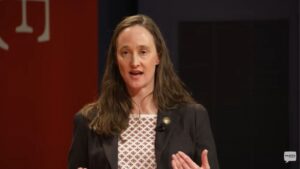
Seattle City Councilmember Dionne Foster is considering the Do Not Solicit registry bill. (Seattle Channel)
(Seattle Channel)
Seattle homeowners could soon get a way to tell real estate buyers to get off their porch and stay off, and the city would enforce it with fines.
The Seattle City Council’s Housing, Arts, and Civil Rights Committee is weighing a new ordinance that would create a citywide “Do Not Solicit List,” letting residents block unsolicited offers to buy their homes through the mail, online, or at the front door. Councilmember Dionne Foster introduced the idea.
The bill targets what the city calls predatory home buying, the practice of investors and flippers cold-pitching homeowners who never listed their property for sale. Backers say the tactic disproportionately hits seniors, low-income residents, and Black and brown homeowners who get talked into selling below market value before they have time to think it through. The Office of Civil Rights would run the registry and enforce penalties starting at $1,000 for a first violation and climbing to $2,000 for each repeat offense within a year, a model the city borrowed from Philadelphia’s permanent citywide solicitation registry rather than New York’s narrower neighborhood-by-neighborhood approach. This is the second swing at the issue in a year.
The council already passed Council Bill 121039 last September, a separate measure requiring buyers who do solicit a homeowner to disclose appraisal rights and give a notice period before any deal closes. That earlier bill regulated the transaction. This one regulates the contact itself.
The city’s case for the registry
“Predatory home-buying practices target the most vulnerable in the community,” the bill’s analysis states, pointing to Seattle’s updated comprehensive plan and the wave of middle-housing rezoning expected to follow. Officials argue that as more parcels become eligible for redevelopment, more investors will start hunting for owners willing to sell quietly, and homeowners need a tool to opt out before the knocks start.
It is a sympathetic pitch. Nobody wants Grandma signing over a Central District lot to a stranger with a clipboard and a sob story about market timing. But “predatory” is doing a lot of work in a bill that, as written, would not actually require proof of predation before a fine attaches.
Once a homeowner is on the list, any unsolicited buyer contact is a violation, regardless of whether the offer was fair, the buyer was polite, or the homeowner would have welcomed it from a different company the following week. The same dynamic that produced Seattle’s worst housing permit numbers in a decade is now being asked to take on another layer of city compliance risk, this time on the buying side rather than the building side.
Does this survive a First Amendment challenge?
Real estate solicitation is commercial speech, which the Supreme Court has long allowed cities to regulate more aggressively than political or religious speech under the Central Hudson test. That is the legal cushion the council is leaning on. It is also why King County’s 2011 door-to-door solicitation ordinance, a much narrower rule restricted to unincorporated areas, explicitly carved out political, religious, and charitable canvassers to avoid exactly this fight; Boy Scouts and church groups were never the target, and the county said so in the text.
Seattle’s draft has not been made public in a form that confirms whether it includes a similar carve-out, or whether “solicitation” is defined narrowly enough to survive a challenge from a real estate investor group claiming the city is singling out one category of commercial speaker for a fine that does not apply to, say, a contractor cold-knocking about a roof.
A registry that applies city-wide rather than to specific blocks, the way Seattle is proposing, also raises a harder question than King County ever had to answer: can a city ban truthful, non-deceptive commercial speech to an entire population simply because some of it might be predatory, or does the ordinance need to be narrower to survive intermediate scrutiny?
Listen to The Jason Rantz Show on weekday afternoons from 3 p.m. – 7 p.m. on Seattle Red on 770 AM (HD Radio 97.3 FM HD-Channel 3). Subscribe to the podcast here. Follow Jason Rantz on X, Instagram, YouTube, and Facebook.
Related
 Washington girls' sports initiative gets major boost after Supreme Court victory
 Washington, Oregon gouge parents on child care; red state Idaho doesn't
 New petition seeks to enshrine right to hunting, fishing in Oregon constitution
 King County brags about 48-day permits while its auditor says the county can’t reliably measure how long they take
 Millionaires renting jumps 709%, suggests Seattle real estate isn’t worth the price
 Socialist mayors to lead LA, D.C., NYC, Seattle as Trump warns of ‘disaster’

Comments
1 Comments
Well, what do you know?
I guess what they say about a broken clock being right twice a day is right. FINALLY something I can agree with the Clowncil.
Can they include the phone calls too?
I always say "Sure. $10 MILLION CASH!!! No questions asked. AS IS and you give me six months FREE rent to find a new home. YOU pay ALL closing costs and taxes/fees"
Believe it or not, I have had a few ask if it was negotiable!!!