
King County sees its highest number of weekly overdose deaths since the start of summer
Weekly overdose deaths in King County just reached their highest number since Memorial Day. One of the victims was a 15-year-old girl.


Drug paraphernalia picked up during a recent We Heart Seattle clean-up. (Photo: Andrea Suarez)
(Photo: Andrea Suarez)
As activists in Washington continue to assure us that the drug and homelessness crisis is a figment of our imaginations, overdoses in King County continue to spiral out of control. In fact, the county just saw its highest number of overdose deaths in a single week since May.
Between August 10 and August 14, 19 drug-related deaths were reported in King County, according to the county medical examiner. One victim was a 15-year-old girl. According to The Center Square, this was the highest number of deaths in a single week since Memorial Day, and the youngest overdose death reported during that period.
The results of a permissive drug culture
Since May 26, there have been 165 overdose deaths in King County, many of which are the result of fentanyl, meth, or cocaine.
“I don’t think we understand just the reverberating effect of widespread drug overdose in Washington state,” Marsha Michaelis, project coordinator and research fellow at the Discovery Institute’s Center on Wealth & Poverty, told The Center Square.
Michaelis pins the blame on a statewide approach to drug use that is far too lax and failed remedies like harm reduction that don’t address the underlying causes of addiction.
“We don’t punish or we don’t have laws against having hard drugs and possessing drugs, we often don’t enforce laws against the selling and trading of drugs. And so we get a predictable result, which is that this substance that for many people is a huge snare,” she said. “Harm reduction is an evidence-based, patient-centered approach to minimize the negative impacts of high-risk behaviors, like drug use.”
King County’s approach has failed
Despite millions of dollars spent on the homelessness crisis, King County’s record is one of failure. Michaelis says the approach taken to homelessness across the region that puts an emphasis on things like low-barrier housing rather than treatment is fundamentally flawed.
“You know, if you talk to people who are in recovery, talk to many addicts, they don’t want to be addicted to drugs. But we are comfort loving creatures. We are pleasure loving creatures. We have a hard time self-regulating,” says Michaelis. “And so when you have good boundaries around your life, a loving family, a good social network, good laws, you know, they’re actually enforced. It really helps human beings live and thrive.”
And it’s not just the individuals who are addicted that pay the price. Urban decay begins to set in as drug use proliferates and society as a whole suffers.
“They can’t walk down the sidewalk. Businesses can’t succeed and thrive because customers don’t want to come into these areas that have been blighted by drug use and open drug markets. And so it hurts everyone, and not least the person who is suffering, who needs the restraints of the law and needs those benefits,” said Michaelis.
Follow Seattle Red on-air at 770 AM, on the Seattle Red app, and streaming audio and video on SeattleRed.com.
Related
 Rantz: Democrats' policy just allowed another infant to die from a fentanyl overdose
 Rantz: Seattle’s fentanyl disaster is so bad that Public Health offers drug overdose guides for dogs
 Rantz: Washington hands out fentanyl foil and needles, then investigates We Heart Seattle for cleaning it up
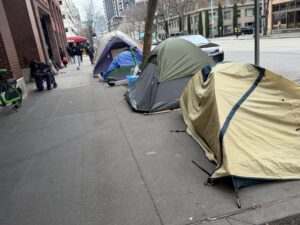 Seattle homeowners turn to barbed wire to protect from dangerous homeless encampments
 From Port Orchard to Walla Walla, 17 groups split $45 million for homeless veterans
 Socialist mayors to lead LA, D.C., NYC, Seattle as Trump warns of ‘disaster’

Comments
2 Comments
And they cry about deaths from guns!!!!
Harm reduction. Yeah, right.