
Rantz: Despite fanfare, Seattle Mayor Katie Wilson’s new Interbay homeless shelter is nearly empty
Mayor Katie Wilson's new Interbay homeless shelter opened with just five residents and won't fill until August, missing the World Cup it was built for.


Seattle Mayor Katie Wilson is proposing a new city fund to help retain startup companies. (Seattle Red)
(Seattle Red)
Seattle Mayor Katie Wilson’s new Interbay homeless shelter, supposedly built to take in people displaced for the World Cup, is sitting nearly empty with only five residents inside and no plan to reach full capacity until at least August. The Bayside Enhanced Shelter opened this month with 75 single-adult units, the entirety of what Wilson delivered against her promise of 500 shelter beds before the tournament.
Wilson set a goal of 500 beds by mid-June and 1,000 by the end of the year. She delivered only 75 units, all of them in Interbay, a shortfall of 85 percent. The first World Cup match kicked off in Seattle on June 15. The shelter was pitched as relief for homeless people swept out of Pioneer Square ahead of the games, yet those people were not moved indoors. They were mostly pushed south into the Chinatown International District and further into Belltown.
The Jason Rantz Show on Seattle Red 770 AM has confirmed the shelter is almost entirely empty and will take months to fill. A shelter that cannot house people during the emergency it was built for is not a solution.
A 75-unit shelter with five people in it
The numbers come directly from Wilson’s own administration.
“The Bayside Shelter is operated and staffed by Everyone Deserves Housing. Client intakes at this shelter are happening on a gradual basis to provide time for staff to work with new residents who have behavioral health and/or substance use challenges and ensure greater stability for everyone at the shelter as well as the surrounding community. This ramp-up approach aligns with standard best practice for opening emergency shelters. Five clients are currently residing at Bayside, and approximately 7-10 new intakes will take place each week until the shelter reaches full occupancy of 75 clients, anticipated by August,” a city spokesperson told The Jason Rantz Show on Seattle Red 770 AM in a statement.
At seven to ten intakes per week, a site that opened with five people will not reach its 75-bed capacity until late summer, well after the World Cup has left town. The shelter that Wilson held up as her answer to homelessness before the tournament will spend the entire tournament mostly vacant, and still underdelivered from the promised 500 shelter beds.
Housing First with no mandate to get clean
Wilson has defended the model as low-barrier and high-support. Residents face no requirement to pursue treatment or sobriety once they are inside.
“We are not requiring treatment for people entering this, and this is really an evidence-based model that we’ve seen be successful, so really we bring people in knowing that the process of recovery is really complicated and difficult, so we’re not demanding that people be abstinent when they enter this village, but there’s repeated efforts to help people along into treatment,” Wilson said.
Except this model is neither evidence-based nor effective.
This is the Housing First approach Seattle has run for years, and conditions on the street keep getting worse under it. Each 70-square-foot unit cost roughly $16,000 to build, with no condition attached that a resident seek help for the addiction or mental illness that put them on the street. If this approach worked, the city would tout its success with data on people getting off the street and becoming self-sufficient. But Housing First advocates have quietly shifted their definition of success over the years, instead pointing to how many people remain in permanent supportive housing, rather than the initial goal of allowing people a lifeline to get their life in order and move into their own housing.
A promise built for a deadline it missed
Wilson has not disputed the shortfall, though she has tried to reframe it as ambition rather than failure.
“So when people say it is a failure not to have created 500 units by now, what I want to say is, as long as there are thousands of people sleeping unsheltered on our streets, yes, we are failing,” Wilson told Fox News.
The reframing followed a punishing stretch for her homelessness operation, including the forced exit of her senior homelessness adviser Jon Grant on June 1. Wilson promised a fast, visible fix before the world came to Seattle. What the city got was 75 pallet homes, five people inside them, and a fill date that pushes past the entire event the shelter was supposed to serve.
Listen to The Jason Rantz Show on weekday afternoons from 3 p.m. – 7 p.m. on Seattle Red on 770 AM (HD Radio 97.3 FM HD-Channel 3). Subscribe to the podcast here. Follow Jason Rantz on X, Instagram, YouTube, and Facebook.
Related
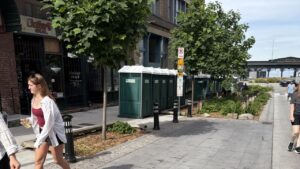 'Slap in the face': City of Seattle blocks business with 13 portable toilets ahead of World Cup matches
 Rantz: Washington skips America 250 fair while funding deportation lawyers, DEI conferences
 Rantz: Rep. Pramila Jayapal is echoing terrorist group to defend a flagged World Cup referee
 Seattle homeowners turn to barbed wire to protect from dangerous homeless encampments
 From Port Orchard to Walla Walla, 17 groups split $45 million for homeless veterans
 Socialist mayors to lead LA, D.C., NYC, Seattle as Trump warns of ‘disaster’

Comments
5 Comments
Shocked I tell ya! No rules to get clean and you want people to stay there? This is the insane thinking of the people who run Seattle.
Seattle insanity at its finest. Create laws and enforce them, that is what works not free homes for drug addicts.
So people don't want to live in a Tuff Shed?