
EPA begins property-by-property hazardous material removal in Spokane fire zone
EPA Region 10 Administrator Emma Pokon details the free household hazardous material removal underway across Spokane County's fire-damaged properties.

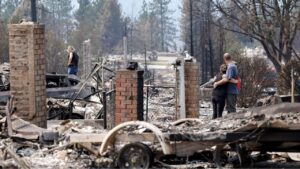
EPA crews began removing household hazardous materials from properties damaged by the Spokane Complex fires this week at no cost to residents. (City of Spokane/Facebook)
(City of Spokane/Facebook)
Federal crews began moving property by property through the Spokane Complex fire footprint this week, pulling damaged lithium-ion batteries, pesticides and chemical containers off burned lots before residents return to sort through what is left. At the request of Washington state, FEMA assigned the Environmental Protection Agency (EPA) to survey, remove and dispose of household hazardous materials on properties hit by the Old Trails, Fairview and Autumn Lane fires. The work costs residents nothing.
The three fires damaged or destroyed hundreds of homes and businesses and forced more than 60,000 people out of Spokane County neighborhoods. Evacuation levels have since been lifted across the burn area, which means thousands of people are walking back onto lots that still hold everything that was in the garage, under the sink and in the driveway when the fire came through.
EPA Region 10 Administrator Emma Pokon was touring the burn areas Tuesday as the agency’s contractors started work. She walked through how the operation runs and what residents should expect to find on their own property.
Two crews, then an audit
Pokon described a staged process that starts with assessment and ends with a marked, cleared lot.
“We have our EPA teams and their contractors on the ground starting today. We have an advance team that comes through and sort of assesses what sorts of hazardous materials are visible and are things that we can address. So that might be things like lithium-ion batteries in a vehicle, it might be containers of bleach or other chemicals, it might be pesticides, and really doing a scan of properties to see what we can appropriately address to reduce risks for residents that are returning to their properties,” Pokon told The Jason Rantz Show on Seattle Red 770 AM.
The second pass is the physical removal.
“And then we’ll have a second crew come through and actually do the removal to get those materials safely handled and safely disposed of, and again, to reduce the risk for folks that are trying to get back to their properties and haven’t gotten through the fire to return and assess their situation, get the information that they need for insurance claims, and maybe recover some things,” she said.
Nearly every property has something to be removed
Asked whether crews expect to find hazardous material at essentially every address, Pokon pointed to burned vehicles as the surprise.
“With the fires coming through, there was really quite a bit of destruction, and so I think it really can vary. I’ve been surprised to learn that a vehicle that’s been pretty totally destroyed by a fire may still have those damaged batteries intact, that can pose an ongoing hazard. So yes, most properties will likely have something that is good to have handled separately and with folks with the proper expertise,” she said.
The EPA has published a Spokane County household hazardous materials fact sheet listing what crews will haul away, and the opt-out form is posted on the Spokane County website.
Working fast without cutting corners
Speed matters with this kind of material, and so does not missing anything. Pokon said the agency borrowed a rule from earlier fire responses.
“One of the lessons learned from prior responses is it’s a slow is fast situation. We received our mission from FEMA a week ago Friday, and the moment the red flag warning was lifted for Spokane, we had our advance team on the ground here in Spokane, getting our staging areas ready, getting all of the sort of logistics straightened out so that when we had the fuller team here starting today, they could really launch with that resident by residence process, going property by property to remove the material,” she said.
She also acknowledged the pressure from families who have been locked out for weeks.
“And yes, we certainly recognize that people really are quite anxious to get back to their homes, back to their properties. A terrible event to live through and experience. So we want to make sure that we are doing our work as promptly as possible to facilitate that return,” Pokon said.
Opting out and getting help
Spokane County granted the access authority, and it is also running the opt-out. Property owners who decline the federal service take on the cleanup themselves. And if you need help, the EPA is a phone call away.
“And that phone number to call for the EPA hotline for residents is 1-888-509-0667. And we can assist coordinating with homeowners and residents to get their properties cleared out of hazardous materials as promptly as possible, or there’s a need for coordination. Heart goes out to everybody in the Spokane area. This is a really tough time, and we want to provide the support we can as promptly and as respectfully as possible,” she said.
The federal response to the fires has drawn rare public thanks from Gov. Bob Ferguson, who sent a letter to the White House crediting the speed of the emergency declaration for six counties and three tribal nations. That stands in contrast to former Gov. Jay Inslee, who used the disaster to relaunch his climate messaging from the other side of the state while an arson suspect sat in custody. Residents on the west side dealing with the smoke drift can also review practical steps to limit exposure indoors.
Listen to The Jason Rantz Show on weekday afternoons from 3 p.m. – 7 p.m. on Seattle Red on 770 AM (HD Radio 97.3 FM HD-Channel 3). Subscribe to the podcast here. Follow Jason Rantz on X, Instagram, YouTube, and Facebook.
Related
 Rep. Baumgartner moves to ban wildfire betting after Spokane arson case
 Rep. Baumgartner introduces legislation to crack down on foreign discrimination in the economy‘Do your job, Bob’: Rep. Baumgartner calls out Ferguson for not enrolling in K-12 voucher program
 Washington’s accounting mistake could cost hundreds of millions in taxpayer dollars
 Mark Cuban calls out Pramila Jayapal’s Medicare for All pitch over Washington’s 22% premium hike
 WA, Oregon join lawsuit over Medicaid work requirements
Comments
0 Comments