
Rantz: Mayor Katie Wilson’s Seattle means I stepped in human waste on a sidewalk, and there’s no plan to fix the mess
Jason Rantz stepped in human waste on a Seattle sidewalk. Mayor Katie Wilson cut her shelter promise and set no target until the 2028 homeless count.

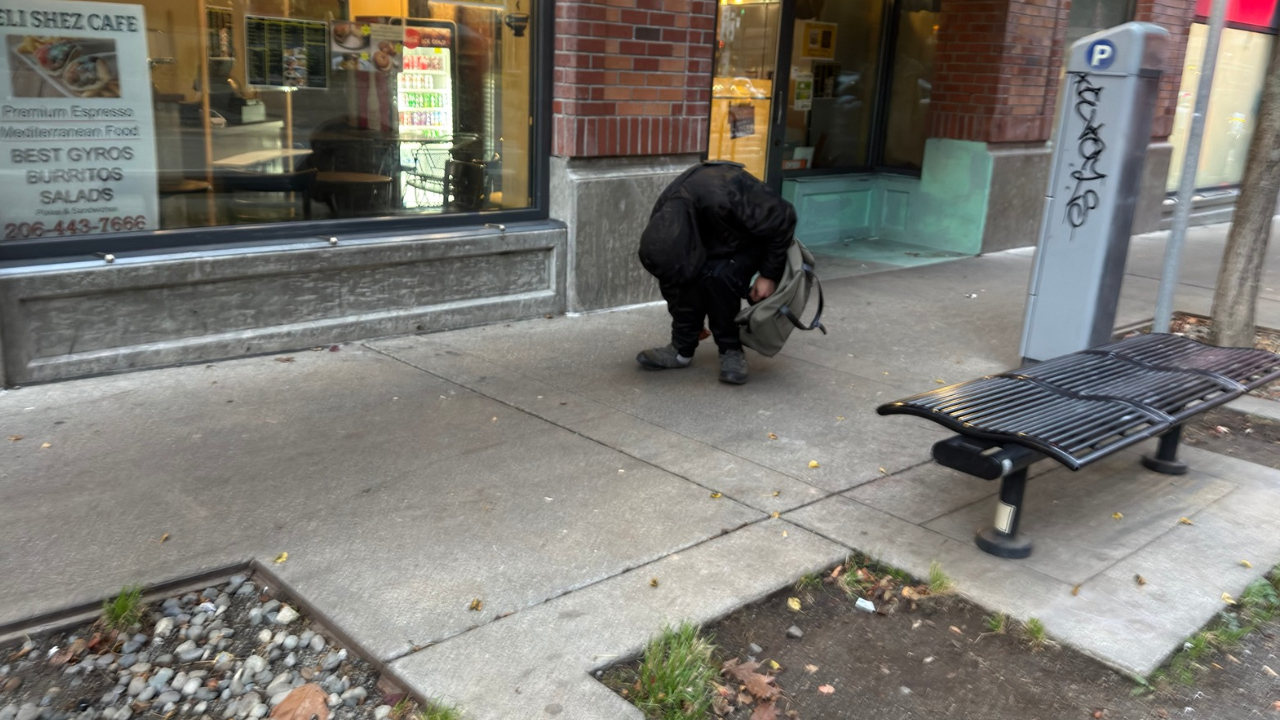
Mayor Katie Wilson has not set a numerical target for reducing unsheltered homelessness in Seattle before the next point-in-time count in early 2028. (Jason Rantz)
(Jason Rantz)
I stepped in human poop on my way to work in Seattle this week. Not dog poop. Human. And no, it’s not a metaphor for Seattle politics, although it works. This poop came from one of the many local homeless drug addicts I walk by every day. Under Mayor Katie Wilson, this is a normal commute, and she can’t tell you how many people she’ll get off the sidewalk or by when. Like many mayors before her, she’s mostly given up on even pretending to care about the crisis she’s making worse.
I had just dropped my dog D’Artagnan off at daycare. I pick up after him every time he poops, though he’s instinctively courteous enough not to go in the middle of a sidewalk. Then I walked toward the office and planted my foot in a pile left by a grown man, almost slipping and tumbling. What made it worse is that it happened right in front of a downtown ambassador with a job description that includes cleaning up that mess. He groaned with me.
About 4,500 people sleep in parks, encampments and vehicles in this city, by the mayor’s estimate. Her office calls it a humanitarian crisis. It’s a sanitation one, too. And she’s not doing anything to make the issue better.
A new life skill for Seattle residents
I stood there on one foot like a flamingo in my BYLT padded jacket. Go back home? Walk into the office smelling like a porta-potty? Or just set the shoe on fire and call it a day? (I ended up going home and throwing my shoe in the washing machine hoping neither the shoe nor the washing machine get destroyed.
So consider this a public service announcement for life in Wilson’s Seattle. Watch wear you’re walking while having your head on a swivel to protect yourself from the aggressive homeless drug addict who just used the sidewalk as his toilet.
The man who left it there
A human being did that on a public sidewalk. Maybe he had nowhere else to go, but was likely too high to care. You’ve seen him slumped against a building at nine in the morning, gray skin, burn marks on his fingers from the foil. He’s dying on that sidewalk in slow motion while the rest of us step around him on the way to work.
He has company. The 2026 point-in-time count found 18,365 people homeless in King County, and 11,829 of them were unsheltered. The total is up 9% since 2024, despite the money that pours into the homeless industrial complex. Their budgets grow with fewer results to show for it. Why solve an issue when they get richer with failure?
King County saw 446 deaths in seven months, which is still about two people a day, and front-line workers in the hardest-hit areas say the overdose encounters remain constant. You can revive the same guy five times. But Narcan doesn’t get him sober, and it doesn’t get him housed. It gets him to tomorrow. And tomorrow, he’s back on the same sidewalk, until he inevitably dies of a fatal overdose.
Fourteen years, and he may walk away
After I cleaned up as best I could, I talked to a small business owner nearby for a cup of coffee. He’s been in the area fourteen years. He was there for 2020 and the pandemic shutdowns, and he survived all of it.
He told me he may not renew when his lease is up.
“It’s never been worse,” he said, noting it’s difficult operating in expensive Seattle as it is.
That’s how a neighborhood dies. One “For Lease” sign, then another, until the guy next door can’t make rent either. Then City Hall commissions a study on why downtown feels empty.
A plan with no finish line
Wilson campaigned as the compassionate alternative. She promised 1,000 new shelter beds a year. In September, staring at a projected $175 million budget shortfall, she cut that promise roughly in half, to 960 beds over two years.
Her new citywide plan is about coordination, with shared lists and a unified care team. Coordination beats chaos, I suppose. But ask the basic question. How many people off the street, and by when? She hasn’t set a number, and the next point-in-time count isn’t scheduled until early 2028. That’s a long time to grade yourself on vibes.
To be fair, the mayor did find the right word at her October 21 press conference. “In the four years before I took office, unsheltered homelessness increased by over 50 percent. This is unacceptable,” Wilson said.
She’s right, but she’s also the mayor now. Blaming the last four years is easy. The pile I stepped in is from this one.
The Seattle City Council voted unanimously to fund part of her $17.5 million tiny home plan. Great. Build them. But a tiny home a man refuses to walk into is just a very expensive shed. Downtown Seattle Association president Jon Scholes calls those men a myth because he’s desperate to keep a seat at Wilson’s table. His statement was embarrassing and disqualifying for having that seat. Anyone who walks Third Avenue knows better.
Compassion with expectations
Leaving a man to relieve himself on a sidewalk, or to smoke fentanyl in a shop doorway until his heart stops, is surrender. It’s inhumane. Seattle compassion kills.
Real compassion has expectations. It tells him he can’t live like this and the city won’t let him; it’s the very attitude that has seen success in Marysville, Bellevue, and Everett. It means a treatment offer the city backs up, cops going after the dealers selling death by the fentanyl pill, and handling a man dying on a Seattle sidewalk like an emergency, because he is one. Instead, the city and county hand out drug paraphernalia.
And it treats the guy who’s paid rent, taxes and payroll for fourteen years like he matters. Because he does, at least to me.
I’ll replace my shoes. That business owner can’t replace fourteen years. And the man who left that mess on the sidewalk can’t replace his life while City Hall waits until 2028 to find out its latest repackaged plan of an old idea didn’t work.
So, Mayor Wilson, give us the number. How many people off Seattle’s sidewalks before that 2028 count, and what happens to the ones who say no?
Listen to The Jason Rantz Show on weekday afternoons from 3 p.m. – 7 p.m. on Seattle Red on 770 AM (HD Radio 97.3 FM HD-Channel 3). Subscribe to the podcast here. Follow Jason Rantz on X, Instagram, YouTube, and Facebook.
Related
 Rantz: Lynnwood scrapped cameras that track car thieves, now wants speed cameras ticketing drivers at 2 a.m. outside empty schools
 Rantz Exclusive: Marine reservist hit with $28,500 Seattle bill after swerving to miss a cat, and the city says the charge is standard
 Rantz: The Education Lab takes Gates and Ballmer money, then prints activist talking points on trans athletes as fact
 Rantz: Washington Democrats raged over a Sea-Tac ICE arrest before anyone knew who agents grabbed because open borders is the point
 Rantz: Washington’s budget squeeze should demand an honest spending debate that Democrats refuse to give
 Rantz: Under proposed WA bail rule, skipping court dates wouldn’t even count as proof you might skip court

Comments
0 Comments