
Chris Cargill: Great Scott! Government wants to regulate predictions
Predictions markets can serve as a valuable economic tool and we don't need government regulating them more than it already is, write Chris Cargill.

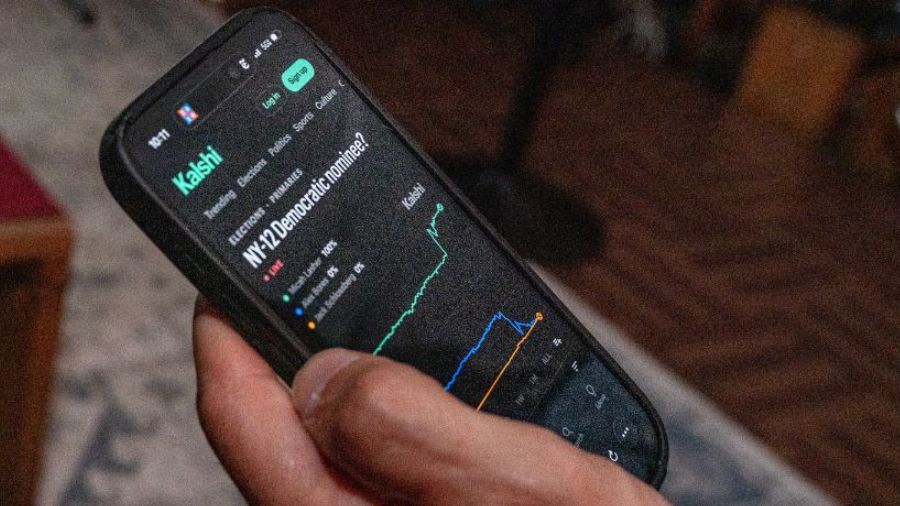
Predictions markets can serve as a valuable economic tool and we don't need government regulating them more than it already is, write Chris Cargill. (Photo by Laura Brett/Getty Images)
(Photo by Laura Brett/Getty Images)
In Back to the Future Part II, Marty McFly travels to the year 2015 and makes a unique discovery: an almanac containing the results of every major sporting event from 1950 to 2000. If he can take it back in time, he could make a fortune betting on games the outcome of which he already knows.
Of course, things don’t go according to plan. Biff Tannen intercepts the almanac and temporarily changes the future timeline. But it causes a viewer to fantasize: what could I do if I knew the future?
Almost four decades after that movie hit theaters, something remarkable is happening. We may not have DeLoreans or sports almanacs, but we do have something that offers a glimpse of what might happen next.
The proliferation of prediction markets
Prediction markets, unlike secret sports almanacs, are available to ordinary people. And more Americans than ever are using them. Which is why so many bureaucrats are salivating at the prospect of regulation.
So, what exactly is a prediction market? Think about it as a stock market for future events. But instead of buying shares of Apple or Chevron, citizens can buy and sell contracts based on whether something will happen. Will interest rates go up? Will a hurricane hit the Gulf Coast? Who will win the next election?
The “price” of the contract reflects what people are willing to pay for that outcome. So, if a contract is trading at 60 cents, citizens believe there’s a 60% chance it’ll happen. And those prices change as more information becomes available.
It’s not unusual.
We use predictions in the economy all the time
Farmers have used futures contracts for generations to protect themselves against falling crop prices. Airlines use financial markets to manage fuel costs. Investors buy and sell contracts tied to interest rates, currencies, and commodities.
And prediction markets are surprisingly accurate. In fact, a 2026 Federal Reserve report showed that prediction markets produce a forecast that has 22% less error than a typical Bloomberg forecast. Put another way, a marketplace of people putting their own money behind their predictions performed better on that measure than a consensus of professional economic forecasters.
That is vital in understanding the difference between prediction markets and simple sports betting. A business concerned about rising interest rates, for example, could use a prediction market to benefit and inform its customers.
It’s not surprising that the government has arrived and is offering to “help.”
Thirty-nine states and the District of Columbia want the U.S. Supreme Court to address whether states can regulate sports-related prediction markets. But you can bet it won’t stop there. States will be itching to regulate, and perhaps even tax any prediction market they can.
Prediction markets are already heavily regulated
But prediction exchanges already operate under federal oversight. A patchwork of state laws will only create chaos.
Imagine if every state had its own rules for the New York Stock Exchange. You might be able to buy a particular financial contract in Idaho, but not Washington. A contract might be legal in Montana, restricted in Wyoming, and subject to entirely different requirements in California. You don’t have to be a psychic to see the potential problems.
Prediction markets operate nationally, and buyers and sellers participate across state lines.
That doesn’t mean states have no legitimate concerns, particularly about sports betting, underage participation, addiction, or market manipulation. Those concerns deserve serious consideration. And it certainly doesn’t mean prediction markets should be allowed to operate without rules.
Policymakers should always make sure fraud is prohibited. Manipulation should be punished. Consumers should receive clear information about risks, and exchanges should be transparent and accountable. But federal oversight already provides a framework for registered exchanges, and policymakers should make that framework effective instead of allowing duplicate laws and 50 different policies.
It is wrong to assume that because something is unfamiliar, it must be regulated. Prediction markets are not going to give us a sports almanac. But they can give us something valuable: A better understanding of what thousands of citizens believe the future may hold.
And, great Scott, that’s something worth protecting.
Follow Seattle Red on-air at 770 AM, on the Seattle Red app, and streaming audio and video on SeattleRed.com.
Related
 Nick Brown sued one prediction market and left the rest alone, and now Kalshi wants to know why
 Judge delivers another blow to prediction market Kalshi's operations in WA
 Chris Cargill: Fact Check—Washington's income tax initiative doesn't "cut" government programs
 Cargill: Washington’s $4 billion budget gap proves Olympia has a spending problem
 Chris Cargill: First report on Idaho ed choice tax credit shows program a monumental success
 Dave Larson: Washington needs to reform judicial election process

Comments
1 Comments
Likely being funded by Indian Casinos whose lobbying in this state is why you're prohibited from online gaming.