
Permanent daylight saving time would mean 9 a.m. sunrises and dark school commutes in Western Washington
Permanent daylight saving time would push Western Washington sunrises past 8:55 a.m., darken school commutes and brighten evenings. Here is who backs it.
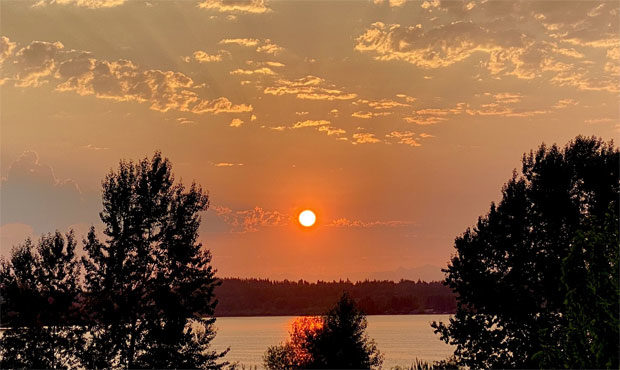
The House-passed Sunshine Protection Act would keep Washington on daylight saving time year-round. (NWS, Twitter)
(NWS, Twitter)
If Congress makes daylight saving time permanent, the sun would not come up in Seattle until 8:57 a.m. in early January, and thousands of Western Washington kids would walk to school in the dark for much of the winter. That is the trade at the center of the Sunshine Protection Act, which passed the House in July and has stalled in the Senate.
The House approved H.R. 139 on July 14 by a 308-117 vote, according to the House Clerk’s roll call. Washington’s delegation split. Republican Representative Michael Baumgartner and Democratic Representatives Suzan DelBene, Kim Schrier, Marilyn Strickland, Emily Randall and Marie Gluesenkamp Perez voted yes. Republican Representative Dan Newhouse and Democratic Representatives Rick Larsen, Pramila Jayapal and Adam Smith voted no.
Washington, in the state legislature, already said yes. A 2019 state law sponsored by then-Representative Marcus Riccelli puts the state on year-round daylight time the moment Congress allows it. Clocks still fall back November 1, and Senate Majority Leader John Thune has doubted the bill can reach 60 votes.
Dark mornings, brighter evenings
Seattle Red calculated sunrise and sunset times for Western Washington cities using standard solar position data. Under the current system, Seattle’s latest sunrise comes around 7:57 a.m. With permanent daylight time, that becomes 8:57 a.m. Bellingham would wait until about 9:03 a.m.
The payoff comes after work. Seattle’s earliest sunset, 4:20 p.m. near the winter solstice, would move to 5:20 p.m. By February 1, the sun would set at 6:10 p.m. instead of 5:10 p.m., giving commuters an extra hour of daylight on the trip home.
Summer would not change at all. Washington already observes daylight time from March to November, so the 9:10 p.m. late-June sunset stays put.
Students would feel the winter change most. A University of Washington biology team’s preprint study, first covered by The Hill, estimates 35 million additional child-days of pre-sunrise travel statewide each year. Seattle elementary students, many of whom start class at 7:55 a.m., would leave home before sunrise on about 58 school days. The researchers also reviewed 20 years of Seattle Department of Transportation collision records and found the odds of a pedestrian being involved in a morning crash were about 2.4 times higher when it was dark.
Supporters and critics
Supporters argue evening light is worth more than morning light and that the twice-yearly switch should end. University of Washington law professor Steve Calandrillo told KOMO that pushing Seattle’s winter sunset an hour later would be a major improvement, citing research tying more evening daylight to fewer crashes. President Donald Trump and Senator Patty Murray both support the bill. British Columbia also adopted permanent daylight time this year, so from November through March, Vancouver, B.C., will be an hour ahead of Seattle unless Congress acts.
Sleep scientists want the opposite. The American Academy of Sleep Medicine opposes the bill and backs permanent standard time, arguing morning light keeps body clocks aligned. Washington could adopt permanent standard time without federal permission, MyNorthwest has reported, but a 2022 bill to do exactly that never advanced.
Even if the bill clears the Senate, it lets states opt out and remain on standard time, leaving the final call with the Legislature in Olympia.
Listen to The Jason Rantz Show on weekday afternoons from 3 p.m. – 7 p.m. on Seattle Red on 770 AM (HD Radio 97.3 FM HD-Channel 3). Subscribe to the podcast here. Follow Jason Rantz on X, Instagram, YouTube, and Facebook.
Related
 Would Americans be healthier without an FDA? Dave Asprey's answer may surprise youWaking up before sunrise in Seattle? Biohacker Dave Asprey says you still need this one thing
 Biohacking leader Dave Asprey says the FDA has no business banning peptides
 Seattle high school allegedly warns students not to skip class as Grand Theft Auto VI finally hits consoles
 King County lost 12.4% of its information jobs since 2022, and Seattle’s payroll tax budget is exposed
 Seattle schools were told to close empty buildings nearly 40 years ago, then shelved the audit when neighbors complained
Comments
3 Comments
With all the problems going on in this country, it’s amazing that congress can’t make a decision on something as simple as this. Make a decision and put this issue to rest.
I agree with Jason on all issues but this one. I favor permanent DST. My main points:
1. Your sunrise/sunset times vary widely depending on where you are in the time zone. And to a lesser extent, your latitude.
2. Daylight amount improves quickly on the backside of 12/21, like 2-3 minutes a day.
3. Kids are already going to school in the dark. We all have had that experience. But wouldn't they appreciate having an hour of daylight after they get home from school?
So instead, they walk home in the dark. And all the rest of us go to work in the dark and leave work in the dark. Permanent DST!!