
Rantz: Washington hands out fentanyl foil and needles, then investigates We Heart Seattle for cleaning it up
Washington L&I opened two inspections into We Heart Seattle over how volunteers collect the used needles and fentanyl foil that public agencies hand out free.

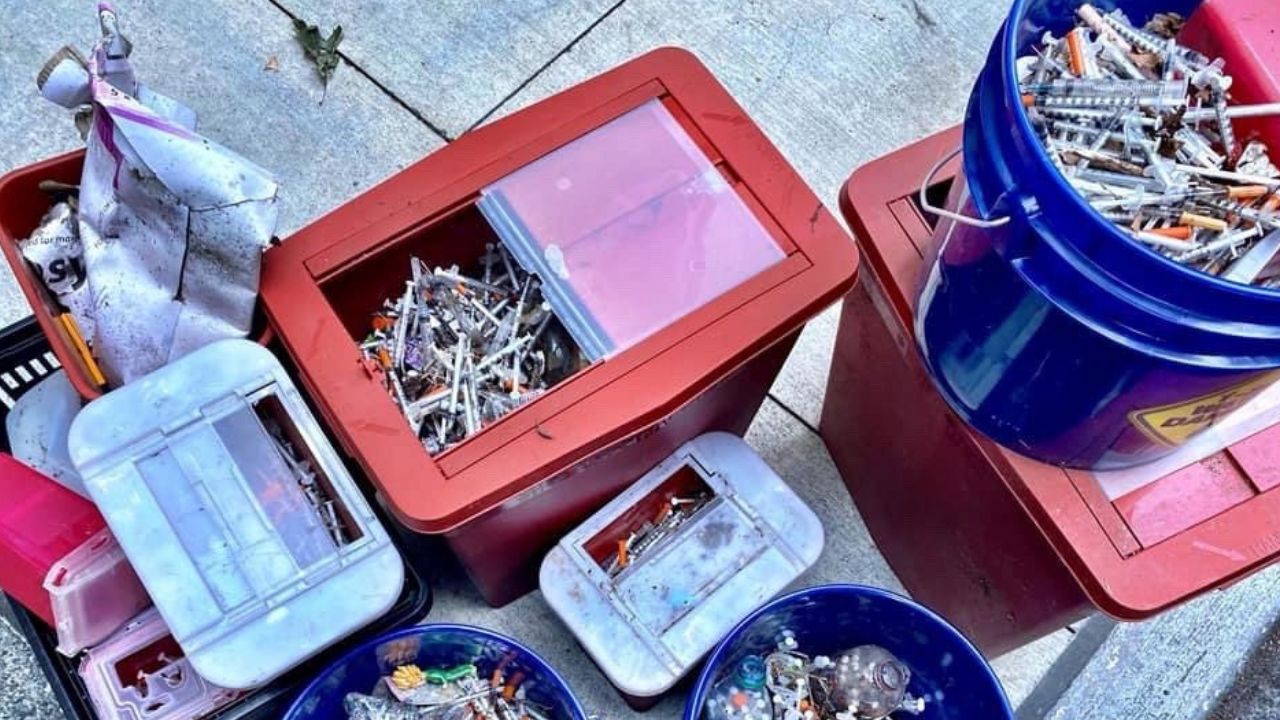
We Heart Seattle faces two state inspections over how its volunteers collect used needles and fentanyl foil. (We Heart Seattle)
(We Heart Seattle)
The Washington State Department of Labor and Industries is investigating We Heart Seattle over the way its volunteers pick up used hypodermic needles and fentanyl foil, the very same drug paraphernalia that government agencies in King County and around the state hand out to homeless drug addicts for free.
State records obtained by The Jason Rantz Show on Seattle Red 770 AM show the Division of Occupational Safety and Health opened the case in July and gave the nonprofit just two days to produce a stack of workplace safety documents. Nobody has opened an investigation into the agencies distributing the foil in the first place.
The referral describes the alleged hazard: “Improper handling and collection of hypodermic needles and fentanyl paraphernalia.” The severity is marked serious.
We Heart Seattle has hauled roughly 2 million pounds of garbage out of Seattle parks, greenbelts, and sidewalks since 2020, work the city, county, and state have never managed on their own. The state’s “thank you note” after six years is a compliance file.
The state gave a one-employee nonprofit two days to produce a safety manual
A July 20 letter from Industrial Hygiene Compliance Officer Emily Brown demanded nine categories of documentation by 6 p.m. on July 22. The list included a written Accident Prevention Program, a Bloodborne Pathogens Written Program, a personal protective equipment hazard assessment, bloodborne pathogens training logs, the six most recent sets of safety meeting minutes, signed hepatitis B offer and declination forms, walk-around safety inspections from the past six months, and safety related employee disciplinary records. If the documents did not arrive, the letter warned, the department would assume they do not exist and proceed accordingly.
Suarez is the organization’s only direct employee. She said she told the inspector the request did not match anything resembling a normal workplace.
“This is an overreach. You should really be looking into why the foil’s there in the first place,” Suarez told The Jason Rantz Show.
The demand for walk-around safety inspections struck her as absurd, since her office is a public park owned by the same government now asking for the paperwork.
What the cleanup protocol actually looks like
Suarez walked through the group’s handling procedure, which she said has not changed in six years.
“We pick up needles with pinchers or tongs with gloves on, and we put them in a red biohazard bucket that is provided to us by the King County Public Health Department,” Suarez said. Volunteers then haul the containers to transfer stations and dump them in the designated sharps area.
Foil is the harder question, and she said the state has no answer for it.
“I think the foil actually is more dangerous because we’ve seen fentanyl pills and drugs stuck on them,” she said. “It’s so prevalent that you just need to put the foil in a plastic bag and treat it like garbage.”
She added that the county’s own public health apparatus has moved on to other priorities. “Of course, we now have flyers coming out of the same agency on how to reverse the overdose of your dog,” Suarez noted. She’s being investigated for cleaning up the consequences of government agencies’ harm reduction model, yet the state doesn’t have an answer for everyday citizens, including kids, who encounter the drug paraphernalia.
As for injuries, she did not pretend the work is risk free.
“We had somebody poked with a needle once or twice,” she said. “I myself have gotten poked by a needle.” She said those incidents came in the group’s earliest days at Denny Park and that the volunteers went to a doctor. The most serious harm anyone at We Heart Seattle has suffered came from somewhere else entirely.
“The only time we’ve been really harmed, Jason, is when one of those Antifa activists shoved one of my guys in the chest,” Suarez said.
She said the practical effect is exactly what a complainant would want, whether or not a fine ever gets issued.
“It’s scary, Jason, because we are just a one-woman operation. We got two miracle worker case managers out there driving people to treatment every day,” she said. Those case managers are formerly incarcerated men now working addiction outreach, and Suarez said she does not want state investigators interviewing them about needle technique.
Who filed the referral
L&I Public Affairs Manager Matt Ross confirmed to Seattle Red that the referral is a disclosable record. “Yes, referrals are public records, and you can file a request for those at our public records page,” Ross wrote in an email. He did not identify the complainant, but did confirm it “came from someone other than an employee or employee representative.”
Suarez has her suspicions.
“But I think that the idiot that referred me was probably hoping that this would somehow harm me. But every time somebody tries to harm We Heart Seattle, we get that much better, faster, stronger,” she said.
The group has spent the past year getting louder about conditions on the ground, including warnings that Seattle’s homelessness and open air drug use are sliding backward and praise for Tukwila’s public camping ban.
Ross explained that “Any organization using employees to handle used sharps is required to follow the same set of basic rules to protect their workers. Generally speaking, they must have: Documented programs for accident prevention specific to the hazards of their work and communication about those hazards to their workers; A documented program for preventing exposure to blood-borne pathogens; and Workers who have access to and use personal protective equipment appropriate to the work.”
The Jason Rantz Show sent the department seven questions. Ross answered two of them. He did not explain the authority under which a single-employee nonprofit working on public property falls within DOSH jurisdiction, or how such a group is supposed to produce walk-around safety inspections for parks and sidewalks it does not own. He did not produce a written state standard for handling used fentanyl foil, pipes, cookers, tourniquets, or spent Narcan cartridges, which leaves open the question of what specific rule the alleged improper handling actually violates.
And he did not answer whether DOSH has ever opened a comparable inspection into the King County needle exchange, the Unified Care Team, city-contracted encampment removal crews, or the downtown ambassador programs, or provide the number of such inspections opened in the last three years.
The agencies handing out the foil are not under investigation
Public Health Seattle and King County distributes harm reduction kits containing glass pipes, tin foil, and printed instructions on folding that foil into a usable pipe, as The Jason Rantz Show has documented after walking into a Belltown needle exchange and leaving with a full kit in three minutes.
“So, you’ve got all of these taxpayer organizations, the ambassadors, the Unified Care Team, all the city contracts that do the encampment sweeps,” Suarez said. “There’s more foil and Narcan and cartridges right now in my alley than I’ve ever seen in six years.”
She said the outcome she actually wants is a policy change rather than a wave of citations against everyone else.
“We shouldn’t have foil on our streets ever. They’re loaded with fentanyl residue,” Suarez said. “Because every single person that lives in downtown Seattle or near a park steps on foil daily.”
The organization’s cleanups have doubled as treatment interventions, with volunteers driving addicts to detox while the county’s outreach model waits for people to ask first. That is the operation the state decided needed a compliance review.
“This is an egregious overreach. They could have stopped and went, Yeah, this probably isn’t where we should use our time and resources,” Suarez said. “And you know what, Jason? No good deed goes unpunished.”
The investigation could take two months or longer, according to what Suarez said the inspector told her.
Listen to The Jason Rantz Show on weekday afternoons from 3 p.m. – 7 p.m. on Seattle Red on 770 AM (HD Radio 97.3 FM HD-Channel 3). Subscribe to the podcast here. Follow Jason Rantz on X, Instagram, YouTube, and Facebook.
Related
 Rantz: Auburn hired zero cops with $3.9M. King County got $15M for just three.
 ‘We’re putting the squeeze on Seattle’: We Heart Seattle’s Andrea Suarez reacts to Tukwila’s homeless camping ban
 Rantz Exclusive: Washington issued, then rescinded license plate spelling out the Trump '86 47' Trump threat
 Rantz Exclusive: Tacoma Democrat arrested in five-car DUI crash one week after winning House primary
 Seattle high school allegedly warns students not to skip class as Grand Theft Auto VI finally hits consoles
 King County lost 12.4% of its information jobs since 2022, and Seattle’s payroll tax budget is exposed

Comments
10 Comments
unbelievable, does the state work for the citizens?
We know the answer.
If WHS isn't in compliance with the safety regs, they should be guided to it. Government looks to make examples of good intentioned people for political reasons. That is overreach, evil, and retaliation. The hypocrisy here is astronomical. I'd like to know how much scrutiny other NGOs get.
Two words. “Fishing Expedition”….