
Seattle retailers warn crackdown on surveillance pricing will worsen affordability crisis
As Seattle considers a ban on surveillance pricing, stores are warning that it would result in higher prices for consumers.


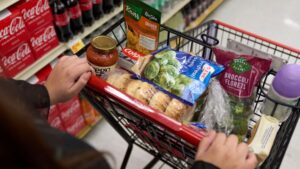
Egg prices in a grocery store on Jan. 8, 2025. (Photo: James Lynch, KIRO Newsradio)
(Photo: James Lynch, KIRO Newsradio)
The Seattle City Council is preparing to introduce the Fair Pricing and Transparency ordinance, which would ban surveillance pricing. This is the practice of using AI and customers’ personal information to set prices.
The idea behind the legislation is to prevent retailers from charging consumers different prices based on personal data. That may be well intentioned, but stores warn that it would put loyalty programs and discounts that customers depend on in peril.
Retailers say the ordinance would put discounts at risk
Critics of the proposal say the language of the bill has too much gray area. “The way the ordinance is currently drafted there’s a lot of ambiguity and concern from the retailer’s perspective,” Amanda Dalton, president of the Northwest Grocery Retail Association (NGRA), told KOMO News. “I think that every retailer’s member loyalty program, discount, savings, coupons, are at risk if it’s not written correctly.”
Dalton says her group is working on a better alternative with the city.
“My members are not using personal information to drive grocery prices,” she said. “The example we use with policy makers right now, you don’t want a bunch of dog food coupons if you own a cat. And if you buy cat food every week, we want to make sure you are getting cat food coupons.”
Bipartisan backlash
Surveillance pricing has been maligned on both sides of the aisle. Earlier this week, Senator Josh Hawley (R-MO) called the practice “one of the biggest scams in American history” and accused retailers of “spying on people, ripping them off, and taking away jobs.”
The Federal Trade Commission (FTC) has also called surveillance pricing a “shadowy ecosystem.”
“Early studies of the surveillance pricing ecosystem have found that different consumers can be offered different prices for the same online product, depending on factors collected about the consumer such as their location, the type of device they are browsing from, or the language of their device,” an FTC study found.
NGRA has also launched Protect Seattle Savings, which says it supports “clear protections that prohibit the use of personal information to charge consumers higher prices.”
“The only people who lose if we get this wrong is consumers, and we’ve made that very clear to the Mayor’s team,” added Dalton.
Follow Seattle Red on-air at 770 AM, on the Seattle Red app, and streaming audio and video on SeattleRed.com.
Related
 Google axes 52 Seattle and Kirkland jobs that Washington Democrats already spent the taxes on
 Seattle ranked the 4th worst metro area for business survival in WA
 Consumers are being crushed by Seattle prices, study finds
 Seattle high school allegedly warns students not to skip class as Grand Theft Auto VI finally hits consoles
 King County lost 12.4% of its information jobs since 2022, and Seattle’s payroll tax budget is exposed
 Two weeks after voters kept Washington’s income tax, Jamie Pedersen is already pitching a new one on businesses

Comments
3 Comments
I am actually surprised that this is coming from the Seattle commies. They usually love the idea of higher prices, taxes and tolls based on an individual's identity or income level. Adjusting prices based on an individual's identity/data is a Communist practice.
So this is a rare case where I actually agree with Seattle's mayor. The phrase of "Even a broken clock is correct twice a day" comes to mind.
And higher prices can, and will, result in decreased sales.
I've been a victim of this "surveillance pricing" on Amazon!!
I will be looking at an item priced for (example) 21.98, then look at a similar item, only to return to the 1st item and the price has all of a sudden changed to 24.98!!!
To get around this, I put the 1st item in my cart knowing that I can/will most likely delete it later when I find a better/less expensive item later!!
I've not had it happen in grocery stores bc I know the prices advertised and closely check my receipt before walking out of the store!