
Bombshell Washington Free Beacon reporting finds race-based housing schemes in Multnomah County
According to the Washington Free Beacon, Multnomah County uses a points-based system that prioritizes minorities for public housing resources.


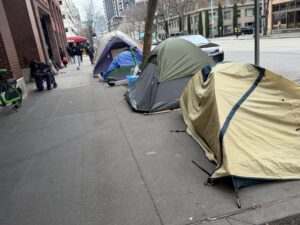
Washington Free Beacon uncovers race-based housing rubrics. (Photo: Kevin Dahlgren)
(Photo: Kevin Dahlgren)
Aaron Sibarium of The Washington Free Beacon has uncovered a controversial, points-based system in Multnomah County, Oregon, that uses race and sexual orientation to determine who gets priority for public housing. Despite the county facing a homelessness crisis where deaths have quadrupled since 2019, the new “Multnomah Services and Screening Tool” awards more points to non-white and non-straight applicants than it does to some domestic violence survivors.
According to documents obtained by the Washington Free Beacon, the rubric is specifically designed to prioritize Black, Indigenous, and People of Color (“BIPOC”) households and the “LGBTQIA2S+” community. The system awards points for several unconventional criteria, such as one point for an “interest in LGBTQ services” and two points for speaking English as a second language. Another two points are given for an “interest in culturally specific services,” which serves as a catch-all for race-based programs.
In practice, a non-white, non-heterosexual who speaks English as a second language can receive up to five points, which is higher than the four points awarded to a domestic violence survivor who has a young child and has been homeless for over a year.
A two-tiered housing system
Sibarium found that this system has created two tiers of housing availability. Several apartment buildings in the area—totaling 447 units built since 2021—are specifically reserved for or “target” racial minorities and those requesting “culturally specific” services.
This means there is significantly more housing available for families identifying as “BIPOC” than for white families, even though the majority of homeless people in the county are white.
These placements include spots at the Hattie Redmond Apartments and the Kathleen Saadat Apartments, which are described as providing “culturally specific housing for the chronically displaced BIPOC community.”
National expansion and Washington State’s role
The investigation identified that these practices extend far beyond Portland, with five states and dozens of cities incorporating racial preferences into their housing programs. Washington State has implemented specific mandates, setting aside $1.2 million in 2024 for “by-and-for” organizations whose primary mission is serving “BIPOC” communities, which The Jason Rantz Show on Seattle Red 770 AM previously reported. This includes specific funding amounts intended for African diaspora and West African immigrants, as well as Hispanic, native, and migrant seasonal workers.
Washington State also requires that 10 percent of its rent relief grants go to organizations that are substantially governed by marginalized populations. Furthermore, the state funds a private program called the Washington Youth and Families Fund, which explicitly prioritizes “BIPOC” and “LGBTQ2+” families for housing assistance.
Other regions have implemented explicit quotas and weighted formulas. In Maryland and Minnesota, race appeared to be the single largest factor in allocating certain forms of rent relief. Some policies use an index from the Urban Institute where race is the most important indicator, receiving twice as much weight as poverty and four times as much weight as being uninsured.
Legal and constitutional challenges
Legal experts interviewed by Sibarium suggested these policies may be unconstitutional. Dan Morenoff of the American Civil Rights Project noted that there is no “compelling” legal reason to choose who sleeps on the street based on their race. Additionally, the Fair Housing Act forbids advertising that indicates a preference for tenants based on race, yet many of these housing projects are explicitly marketed toward specific racial groups.
“There is no ‘compelling’ reason to choose who sleeps on the streets by race,” Morenoff said. “No governmental housing program ‘prioritizing’—and necessarily de-prioritizing—homeless families by color, as Multnomah County’s screening system openly does, should be expected to survive judicial scrutiny.”
Additionally, the Fair Housing Act forbids advertising that indicates a preference for tenants based on race, yet many of these housing projects are explicitly marketed toward specific racial groups. Gail Heriot, a former member of the U.S. Commission on Civil Rights, added that “for a state or local government to treat one homeless person better than another on account of that person’s race is illegal and unconstitutional.”
Follow Seattle Red on-air at 770 AM, on the Seattle Red app, and streaming audio and video on SeattleRed.com.
Related
 Portland School Board declines to revive local fundraising model despite budget gap
 Spokane County looks to crack down on homeless encampments on private property
 Jon Scholes slams the ‘lack of intervention’ as $13 million goes missing from homeless authority
 Portland Mayor proposes $8.5 billion budget with cuts to police and homeless services
 Seattle homeowners turn to barbed wire to protect from dangerous homeless encampments
 From Port Orchard to Walla Walla, 17 groups split $45 million for homeless veterans

Comments
1 Comments
Washington State just keeps getting better and better!