
Rantz: Jay Inslee is lying about Washington’s emissions record — the numbers prove it
Jay Inslee cherry-picked a benchmark to claim success. Washington still exceeds its 1990 legal baseline — and the CCA data predates his own tenure.

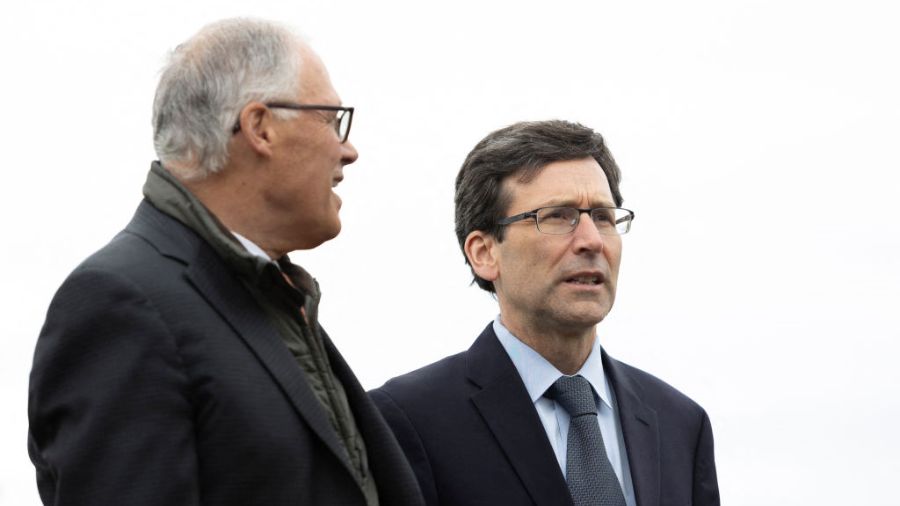
WA democrats Washington state Governor Jay Inslee (L) and Washington Attorney General Bob Ferguson (R)) are pictured before speaking to media and people gathered at Kerry Park about patient's rights to abortion and reproductive healthcare during a pro-choice rally in Seattle, Washington on May 3, 2022. (Photo: Jason Redmond/AFP via Getty Images)
(Photo: Jason Redmond/AFP via Getty Images)
Former Washington Governor Jay Inslee posted something on social media this week that was intended to mislead, while patting himself on the back. After all, he was once labeled the “climate daddy.” It doesn’t take much more than a casual review to realize what he’s doing.
“We are reducing carbon pollution and growing our economy,” the former Washington governor wrote of a new Department of Ecology propaganda report on clean energy. “Don’t tell us it can’t be done.”
That’s not what the numbers actually show. The Greenhouse Gas Emissions Interim Inventory Report for 1990-2022 is a reasonable antidote to Inslee’s self-congratulation. He didn’t cite a false statistic. He picked the benchmark that flatters him and ignored the main one that matters.
We are reducing carbon pollution and growing our economy. Don’t tell us it can’t be done. https://t.co/xYrvPUXlAe
— Jay Inslee (@JayInslee) April 27, 2026
Washington still hasn’t met its 1990 emissions target — the one Inslee signed into law
State law under RCW 70A.45.020 required Washington to return emissions to 1990 levels by 2020. The 1990 baseline was 93.1 million metric tons of carbon dioxide equivalent (MMT CO2e). By 2022, Washington sat at 96.1 MMT CO2e (p. 6). That’s above the legal line, not below it. And when you review the 30 years of data, there’s been almost no overall movement. Yet, by magic, the state is claiming that moving forward, the emissions will miraculously decline because they put it in a graph.
Inslee measures from the year 2000, when emissions peaked at 109.6 MMT CO2e. That framing produces a 12.4% reduction, which sounds meaningful until you realize state law doesn’t measure from 2000. It set 1990 as the benchmark. Inslee governed the state for twelve years. He signed laws that created those very targets. Choosing the other number is a political decision to brag about success that didn’t come. And the extent that you can even brag here, that 12.4% reduction had nothing to do with any environmental policy.
Pointing to 2020, when Washington briefly clocked 89.2 MMT CO2e and technically grazed the limit is hardly meaningful. The report shows why that number is hollow. Transportation emissions that year dropped to 31.6 MMT CO2e, down from 40.6 in 2019 (p. 11). That wasn’t a policy result. That was COVID. Planes weren’t flying. Freight was suppressed. Commuters weren’t commuting. By 2022, transportation had already bounced back to 38.6 MMT CO2e and sat 9.1% above its own 1990 baseline (p. 13).
The emissions data predates the Climate Commitment Act Inslee is bragging about
Ecology’s own report makes this uncomfortable for Inslee. It states that its findings “predate the onset of many of Washington’s major climate policies, including the Climate Commitment Act (CCA), which took effect in 2023 or later” (p. 7). The agency adds that future inventories will show whether those policies actually produced reductions.
The emissions trends Inslee is claiming happened before his signature legislation existed. The data runs through 2022. The CCA started in 2023. And it’s still not even all that impressive.
“missions are still higher than they were in 2017 and to meet the state’s 2030 targets would require three COVID-scale reductions between 2025 and 2030,” Washington Policy Center’s Todd Myers noted.
Washington’s emissions dip came from weather, not climate policy
Washington’s relatively clean electricity profile also depends substantially on hydropower, which rises and falls with rainfall and snowpack rather than government mandates. The report notes that hydropower production dropped roughly 10% over 20 years and declined sharply after 2017 (p. 20). In low-precipitation years, Washington imports more fossil fuel power and emissions go up. That’s a weather story, not a climate policy story, and Inslee’s framing never acknowledges it.
Ironically, by the way, it’s Democrats trying to pull out our hydropower infrastructure to protect salmon habitat.
The Climate Commitment Act cost drivers real money while delivering unverifiable results
Since Inslee wants credit for the Climate Commitment Act, it’s worth noting that Washington families have been paying an estimated 40 to 60 cents more per gallon of gas since the CCA took effect, according to the Washington Policy Center, helping push the state to some of the highest pump prices in the country. The question of whether Washington residents are getting anything for that cost is, at this point, unanswered by the data.
It gets worse when you look at how the state tracks the CCA’s impact. The Department of Commerce admitted a data entry error that overstated emissions reductions from eight CCA-funded projects by a factor of 96, according to MyNorthwest. Seven and a half million claimed metric tons of reductions turned out to be 78,000. The Department of Ecology published the inflated number anyway, and its director praised the report for providing “detailed, transparent information.”
Inslee’s legacy: above the legal limit, higher gas prices, and inflated numbers
The Ecology report Inslee is now citing to tout his legacy covers data through 2022, a year before his flagship climate law even started.
As SeattleRed has reported, Inslee spent years insisting the CCA would cost drivers mere pennies at the pump. That turned out to be false too. Washington is still above its 1990 legal baseline, families are paying more for gas and electricity, and the state’s own data shop can’t accurately count the reductions it claims to have achieved.
But sure. Don’t tell him it can’t be done!
Listen to The Jason Rantz Show on weekday afternoons from 3 p.m. – 7 p.m. on Seattle Red on 770 AM (HD Radio 97.3 FM HD-Channel 3). Subscribe to the podcast here. Follow Jason Rantz on X, Instagram, YouTube, and Facebook.
Related
 Jay Inslee called 'soulless ghoul' for Jan. 6 post after White House Correspondents' Dinner shooting: Jason Rantz
 Rantz: Patty Murray spent a year calling Trump a tyrant. When someone tried to kill him, she waited two days to say almost nothing
 Rantz: Bob Ferguson keeps calling himself a fiscal moderate. Moody's just called his bluff
 Rantz: Lynnwood scrapped cameras that track car thieves, now wants speed cameras ticketing drivers at 2 a.m. outside empty schools
 Rantz: The Education Lab takes Gates and Ballmer money, then prints activist talking points on trans athletes as fact
 Rantz: Under proposed WA bail rule, skipping court dates wouldn’t even count as proof you might skip court

Comments
2 Comments
It was just a "reset" like Sound Transit does every time they miss a budget or a schedule.
We're talking about the same man who shuttered the vehicle emissions testing sites in 2020. It's a tad incongruous that Inslee would have decommissioned these sites if he was genuinely concerned by emissions and the climate. Then too, I can't imagine the state was losing money on mandatory testing, so what's the motivation?