
Ferguson signs law retroactively voiding Washington non-compete agreements, UW economist warns of economic fallout
Gov. Bob Ferguson signed HB 1155, retroactively voiding Washington non-compete agreements. UW economist Victor Menaldo warns it threatens business confidence.

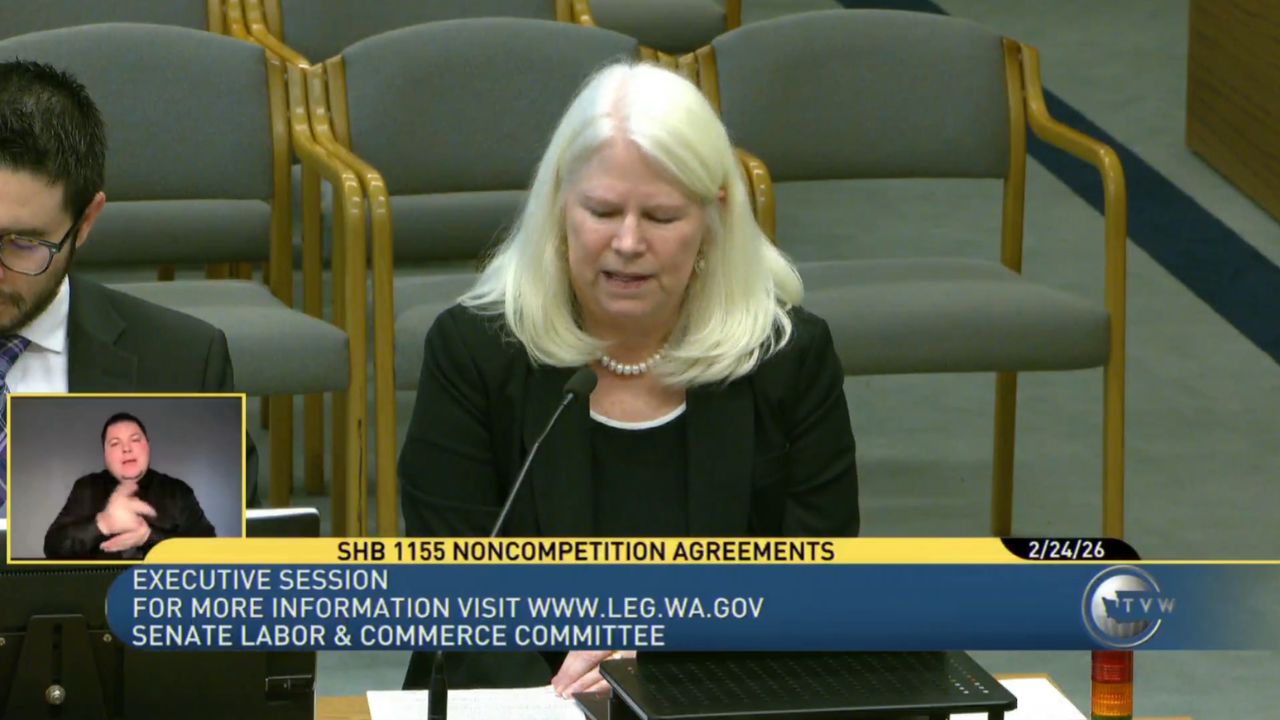
Washington state's Senate Labor & Commerce Committee takes up SHB 1155 — a bill that would retroactively ban non-compete agreements — during a Feb. 24, 2026 hearing. (TVW)
(TVW)
Governor Bob Ferguson signed a law last month that will retroactively void thousands of non-compete agreements across Washington state, wiping out contracts workers and businesses negotiated in good faith, with no individual review and no compensation. The law takes effect in June 2027. But the damage to business confidence starts now.
University of Washington political science professor Victor Menaldo, a political economy expert and author of the forthcoming book The Political Economy of AI, wrote an op-ed in the Seattle Times arguing that even critics of non-competes should be troubled by how Olympia went about this. He joined The Jason Rantz Show on Seattle Red 770 AM to unpack what House Bill 1155 actually does and why Washington’s tech sector is already running out of patience with the state’s policy spiral.
What HB 1155 actually does
The headline says “ban non-competes.” Menaldo said the fine print goes further than that.
“The bill will void those contracts and render them unenforceable, not only going forward, but retroactively,” Menaldo explained. “Moreover, it’s broad enough, the language in the bill, that it might also impact these things called equity forfeiture clauses, which basically means you have to give back invested stock options if you leave for a competitor, and bonus clawbacks, another fancy word for something simple, which is you have to give back a bonus if you leave for a competitor. If that’s under the scope of the law as well, it creates a lot of uncertainty for employers and employees.”
The legislature leaned on a 2024 FTC rule banning non-competes nationwide as its intellectual foundation for the bill. There’s just one problem. The FTC dropped that rule before Washington Democrats used it as their justification.
“If the FTC itself doesn’t have the resources or legal standing to support its own rule, then why are we citing that rule?” Menaldo said. “That just doesn’t seem like a good intellectual foundation for the non-compete reversal. If you want to defend it some other way, fine, but that just seems like weak sauce to me.”
The retroactivity problem
Menaldo is not a blanket defender of non-competes. He acknowledged there’s correlational evidence they suppress wages in certain occupations and limit job mobility. But retroactively voiding contracts people signed in good faith is a different category of problem entirely.
“The fancy term in political economy is legislative reversal risk,” he said. “That’s a euphemism for costs will go up, because uncertainty breeds costs. Now folks are wondering, on both sides, employers and employees, what’s next? Arbitration clauses, non-solicitation provisions? It sets a precedent with no principled stopping point, and so that really erodes the credibility of a functioning legal system where contracts have to be secure. If they’re not enforceable tomorrow, why should I sign today?”
Companies like Amazon and Microsoft run on training investments and proprietary knowledge. When the legal floor shifts under those arrangements without warning, the hiring decisions in Washington changes.
Washington’s tech economy at risk
Banning non-competes doesn’t eliminate the problem employers were using them to solve. It just redirects it somewhere less visible, and possibly less regulated.
“Employers are still going to need to solve this return on investment problem,” Menaldo said, “and so they’re going to find other ways of doing it. They’re going to maybe use NDAs a lot more, confidentiality agreements, or they’re going to use cash compensation instead of stock options. Or they’re going to automate the jobs away, perhaps. And so that’s a distortion, and those other areas are less regulated, and so therefore it could be that employees are hurt even worse than they were to begin with.”
Banning non-competes has its defenders
Some defenders of the ban point to California, which has prohibited non-competes since the 1870s and built Silicon Valley around it. Menaldo pushed back. California developed that model over 150 years, around a venture capital ecosystem and a labor density centered on Stanford and Berkeley that Washington simply doesn’t replicate. The two states are not the same animal.
“I think that at the margin, do I hire someone coming out of UW at a firm in the tech sector here in Seattle, or do I hire someone else, somewhere else? I think that matters,” Menaldo said. “We’re dismantling things that, as a whole, lead to a very vibrant ecosystem, whether it’s the new millionaires tax or whether it’s changes in labor law or contracts in general. That’s where I’m worried that we’re just flying blind and not really thinking about the downstream effects.”
Washington is already the fifth most expensive state in the nation, and its costs are rising faster than anywhere else in the country. Retroactively voiding private contracts is not the kind of policy that makes employers more confident about staying. It’s the kind that makes them start pricing in the possibility that the next thing Olympia decides to fix will also come at their expense.
Listen to The Jason Rantz Show on weekday afternoons from 3 p.m. – 7 p.m. on Seattle Red on 770 AM (HD Radio 97.3 FM HD-Channel 3). Subscribe to the podcast here. Follow Jason Rantz on X, Instagram, YouTube, and Facebook.
Related
 Rantz: Seattle is a homeless magnet because neighboring cities crack down on camping
 Cliff Mass calls Washington wildfire drought warning 'bogus,' says science doesn't back it up
 Rantz: March inflation spiked on energy prices — it's not a repeat of 2022
 Portland streets are crumbling as city leaders debate new fees
 Everett wants $5 million for a new housing fund. Where will it go?
 Skip Black Friday: Saturday has the deepest online discounts, but Seattle’s sales tax eats nearly a quarter of your coupon

Comments
0 Comments