
We Heart Seattle exposes alleged drug house in tiny home village. Is your neighborhood next?
Andrea Suarez banned after exposing a "drug den" in a taxpayer-funded Seattle tiny house village.

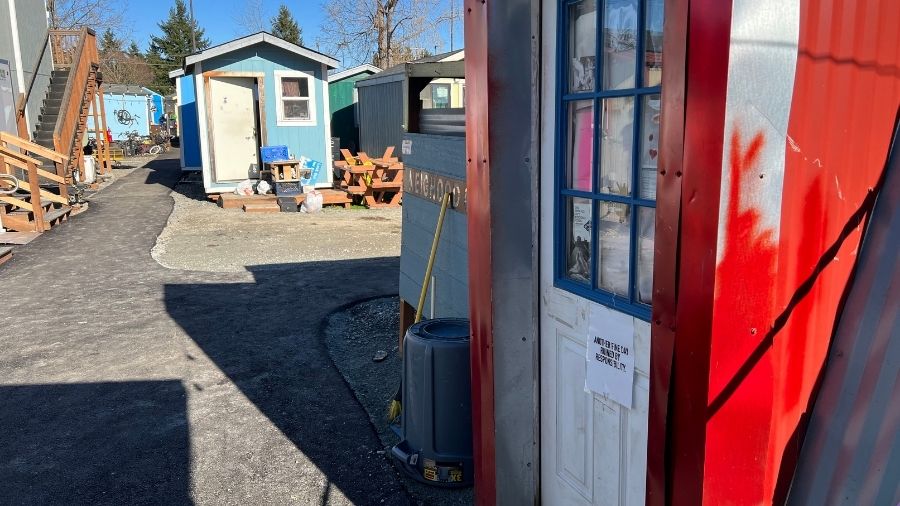
Seattle tiny house "drug den" exposed. (Jason Rantz/KTTH)
(Jason Rantz/KTTH)
A viral video exposing a taxpayer-funded tiny house village being used as a “safe house” for hard drug use has caused pushback. The footage, posted by We Heart Seattle founder Andrea Suarez, shows a resident at the Interbay Village in Seattle, operated by the Low Income Housing Institute (LIHI) pointing out a unit allegedly designated for using fentanyl and other drugs.
According to the resident in the video, the “safe house” is used to ensure people do not overdose alone, though they also alleged a drug dealer lives within the village. Suarez, whose organization focuses on cleaning up drug-infested areas and directing users toward treatment, called the situation “morally wrong” and a misuse of public funds.
State law strips local control over homeless housing
According to The Center Square, after the video was posted, LIHI staff informed Suarez she has been blacklisted and is no longer allowed on the property. Village managers reportedly cited filming without permission as the reason for the ban. Suarez argues that taxpayers have a right to know that these “low-barrier” projects often allow open drug use without requiring treatment, essentially turning them into “trap houses.”
The controversy at Interbay Village comes just as Governor Bob Ferguson signed House Bill 2266 into law. This measure strips cities and counties of their power to decide where low-barrier housing projects and emergency shelters can be located.
Don’t hate the player, hate the game. Funding requires low barrier (drugs allowed), and “harm reduction” practices like this dedicated volunteer built tiny home to smoke illegal and lethal Fentanyl. Do the voters know they are paying for this and to be installed in their… pic.twitter.com/nPuMPS72Wm
— We Heart Seattle (@weheartseattle) March 24, 2026
Under the new law, permanent supportive housing and transitional housing must be permitted in any zone where residential homes or hotels are allowed. Governor Ferguson defended the move, stating it creates “clear statewide standards” and ensures more residents have a place to call home.
Republicans worry the law forces these “drug-den” style environments into residential neighborhoods against the will of local communities. Suarez warned that without treatment requirements, these villages fuel a “supply chain” of crime, including retail theft and the sex trade, as residents struggle to fund their addictions.
Follow Seattle Red on-air at 770 AM, on the Seattle Red app, and streaming audio and video on SeattleRed.com.
Related
 Cliff Mass debunks the left-wing media myth that low snowpack causes wildfires
 Sheriff Derek Sanders blasts TCSO hiring critics, says department rejects nearly 3 in 4 screened applicants
 Seattle homeowners turn to barbed wire to protect from dangerous homeless encampments
 From Port Orchard to Walla Walla, 17 groups split $45 million for homeless veterans
 Socialist mayors to lead LA, D.C., NYC, Seattle as Trump warns of ‘disaster’
 KCRHA head resigns weeks after external review found $16.7M unrecoverable funding

Comments
0 Comments