
Idaho debates joining national push to force a federal balanced‑budget amendment
Idaho lawmakers debate joining states using constitutional powers to force Congress to balance the budget.

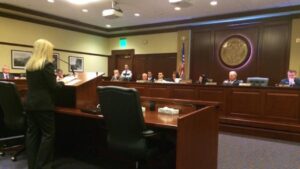
Idaho Republicans split on child neglect bill. (Photo courtesy of Idaho Legislature)
(Photo courtesy of Idaho Legislature)
One reason the federal government has become so dysfunctional—it can’t even balance its own budget—is that a key “check and balance” in the Constitution remains unused. This is the right of the people, through their state legislatures, to propose and adopt corrective constitutional amendments.
Our Founders considered this right to be highly important—possibly even more important than the President’s veto. If it had not been in the Constitution, the American people likely would have rejected the document entirely.
What is happening in Idaho and how it works
The Idaho Senate is considering a resolution to join with other states in using the procedure to require Congress to balance the federal budget. The Idaho House already has approved this resolution. It is well worth the debate.
The Constitution’s procedure is as follows: First, state legislatures send “applications” to Congress. These are resolutions directing Congress to call what the Constitution labels a “convention for proposing amendments”—a meeting of representatives from state legislatures to consider constitution amendments on designated topics.
Once two-thirds of the states (34) pass matching resolutions, Congress issues a “call” specifying time, place, and subject matter.
The voting process and addressing objections
Each state legislature then picks a delegation to meet at the appointed time and place. At the convention, each state delegation has one vote.
A majority of the delegations present and voting may propose an amendment within the scope of the “call.” But the proposal does not become part of the Constitution unless three fourths of the states (38) vote to ratify.
The vote in the Idaho House was 36-34 to advance the proposal. Perhaps some are happy with the federal government as it is. But others were persuaded by objections that have been bandied about for nearly 60 years—even though all of them were rebutted long ago.
Debunking myths about control and money
Let’s go through the chief objections:
Objection #1: “Congress would control the process, leaving states at its mercy for the rules and who the delegates are.”
Answer: This is inaccurate. The Founders designed this procedure specifically to bypass Congress. The convention is under the control of the state legislatures, not of Congress. If Congress tried to intervene, the courts would step in, or the sponsoring states could pull the plug.
Objection #2: “The convention could not be controlled. It could recommend wholesale changes to the Constitution.”
Answer: This is called the “runaway” objection. Notice that it directly contradicts the first objection, which was that Congress would control the convention.
Historical facts and the importance of action
The “runaway” objection was first promoted widely in the 1960s and 1970 by influential liberal figures who wanted to frighten away the states from using this procedure. However, today no serious expert takes this objection seriously. All recent credentialed scholarship acknowledges that the convention is limited to the agenda defined by the sponsoring states. Any action outside that agenda would be void.
Objection #3: “The Constitutional Convention of 1787 is an example of a convention that exceeded its power. It was called by Congress only to recommend amendments to the Articles of Confederation, but it recommended an entirely new constitution.”
Answer: This also is inaccurate. Virginia, not Congress, called the Constitutional Convention, and Virginia called it to consider any and all changes in the political system.
This objection also disregards the fact that none of the other 40+ “conventions of states” in U.S. history has “run away.” If it had, its actions would have been legally void.
Legal safety nets and future impact
Moreover, in modern conditions, a “runaway” convention is not even remotely possible. This is because convention proceedings would be open to the public and state officials could immediately recall any delegate who tried to get off script.
Objection #4: “The 38-state ratification requirement isn’t a real protection since the convention could just propose a new ratification process.”
Answer: This objection contradicts centuries of judicial precedent, from the Supreme Court on down. The courts uniformly hold that all participants in the amendment process—Congress, the state legislatures, and conventions—must follow the rules laid out in the Constitution. A federal court re-affirmed this only a few weeks ago.
Objection #5: “Big money is driving this effort.”
Answer: The only big money involved in this controversy is spent by groups who oppose a convention. Several of those groups are funded in part by socialist billionaire George Soros.
Why amendments matter and Idaho’s opportunity
Objection #6: “Amendments won’t make any difference anyway.”
Answer: No one familiar with American history can believe this. Constitutional amendments have an enormous influence on American life. Think of the Bill of Rights, the 19th amendment guaranteeing the vote for women, and the 22nd amendment limiting the President to two terms.
Bottom line: Our Founders gave us a precious constitutional right to correct the federal government when it has gone off the rails. It is our privilege, and obligation, to use it, and Idaho has the opportunity to join the majority of other states that have voted to do so.
Rob Natelson, a former University of Montana constitutional law professor, is Senior Fellow in Constitutional Jurisprudence at the Mountain States Policy Center, an independent research organization based in Idaho, Montana, Eastern Washington and Wyoming. Online at mountainstatespolicy.org. Rob authored the book “The Original Constitution,” and Justices of the U.S. Supreme Court have cited his constitutional research repeatedly.
Follow Seattle Red on-air at 770 AM, on the Seattle Red app, and streaming audio and video on SeattleRed.com.
Related
 Idaho Republicans advance stricter immigration laws
 Idaho governor pulls human rights commissioner after anti-ICE social media posts spark backlashExperts explain why Idaho’s Article V effort won’t trigger a runaway convention
 Cargill: Washington’s $4 billion budget gap proves Olympia has a spending problem
 Chris Cargill: First report on Idaho ed choice tax credit shows program a monumental success
 Dave Larson: Washington needs to reform judicial election process
Comments
2 Comments
I'm glad the odds of a runaway convention are slim, in theory. However, and with Biden's administration under our collective belts, we know where there's a will, there's often a way to go sideways.
38T% in favor