
Why Washington’s new income tax proposal ignores the voters
Washington lawmakers push a new income tax despite voter opposition, legal precedent, and constitutional concerns.

The Washington State Capitol in Olympia, where Gov. Bob Ferguson signed SB 6346 on March 30, 2026, imposing a 9.9% income tax on income above $1 million. (Photo by David Ryder/Getty Images)
(Photo by David Ryder/Getty Images)
Despite Washingtonians consistently and overwhelmingly rejecting income taxes and the legislature in 2024 enacting I-2111 to prohibit state or local income taxes, some lawmakers in the Evergreen State are again pushing for an income tax this year.
The proposals are initially structured as a 9.9% income tax on “millionaires.” Nearly 100 years of state supreme court legal precedent in Washington, however, prohibits a non-uniform income tax in excess of 1%.
Constitutional amendments and judicial precedent
Why isn’t this income tax structured as a constitutional amendment? Prior legislatures understood that to impose a non-uniform income tax in excess of 1%, a constitutional amendment was required, as occurred (though rejected by the people) in 1934, 1936, 1938, 1942, 1970, and 1973.
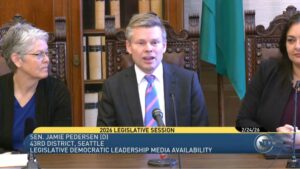
Senator Pedersen, one of the income tax sponsors, said this about the proposal: “We want the state Supreme Court to reconsider its ruling. That is not a bug; that is a feature of the proposal.”
As the state supreme court noted in 1960, however, an income tax should be decided with a constitutional amendment: “The argument is again pressed upon us that these cases were wrongly decided.
The court is unwilling, however, to recede from the position announced in its repeated decisions. Among other things, the attorney general urges that the result should now be different because the state is confronted with a financial crisis. If so, the constitution may be amended by vote of the people. Such a constitutional amendment was rejected by popular vote in 1934.”
Economic competitiveness and tax swaps
Why isn’t this income tax proposal structured as a tax swap to reduce the tax burden? Prior income tax proposals (though rejected by the people), such as the 1973 proposed constitutional amendment, would have prohibited excess school levies in exchange for an income tax.
Are there concerns about the state’s economic competitiveness by going from no general wage income tax to a 9.9% rate? If adopted, this would be one of the highest income tax rates in the country and region.
How would adding a volatile income tax improve the state’s budget sustainability? As noted by Washington’s January credit rating by S&P: “Sales-tax-based revenue structure, which has demonstrated less sensitivity to economic cycles than that of income-tax-reliant states.”
Revenue volatility and budget sustainability
California’s Legislative Analyst’s Office also warns: “This revenue volatility has contributed to major problems for state policymakers attempting to manage and balance California’s state government budget . . . California’s heavy dependence on the volatile PIT (Personal Income Tax) has been especially important…this progressive structure also magnifies the effects on revenues of the earnings volatility of higher income households.”
Why does imposing an income tax that doesn’t take effect until 2028 necessitate denying citizens their constitutional right of referendum on the proposal today (Section 1007 of the bill)?
Especially in the context of Washingtonians rejecting 10 straight income tax proposals, wouldn’t it be more respectful of voters to proactively send this tax to the ballot for their consideration instead of explicitly prohibiting a referendum?
The history of income taxes across the country is to start with high earners and then expand to more taxpayers. How are taxpayers to trust that this won’t occur on this proposal unless constitutionally restricted?
Future implications and legislative intent
This is especially concerning when one of the income tax sponsors, Sen. Pedersen, said this about repealing the I-2111 income tax ban adopted in 2024: “That was — what did Mary Poppins call that? — a ‘pie crust promise.’ Easily made, easily broken. We put that language into statute, and we can amend it any time we want to. I wouldn’t take that super-seriously.”
The income tax proposals in Washington are SB 6346 and HB 2724.
Regardless of the actual details and potential fiscal impacts of the proposed income tax, if Washington lawmakers truly respect the rule of law, this proposal should be restructured as a constitutional amendment.
Jason Mercier is Vice President and Director of Research of Mountain States Policy Center, an independent research organization based in Idaho, Montana, Eastern Washington and Wyoming. Online at mountainstatespolicy.org.
Follow Seattle Red on-air at 770 AM, on the Seattle Red app, and streaming audio and video on SeattleRed.com.
Related
 Rantz: Washington Democrats' cigarette tax is blood money in plain sight
 Washington bill aims to speed up state construction and save taxpayer money
 Washington proposal seeks to end legislative secrecy and expand public access to records
 King County lost 12.4% of its information jobs since 2022, and Seattle’s payroll tax budget is exposed
 A year after fencing off pothole money for the World Cup, Seattle’s council keeps a 29% cut in play
 Two weeks after voters kept Washington’s income tax, Jamie Pedersen is already pitching a new one on businesses
Comments
2 Comments
Senator Pedersen, one of the income tax sponsors, said this about the proposal: “We want the state Supreme Court to reconsider its ruling."
This is the reason they are forcing some judges to retire - so old side show bob can appoint leftists in their place to assure the supreme court will avert the will of the people. WE DO NOT WANT AN INCOME TAX. They need to stop their crazy spending.
These people are all liars. I think most people saw the list of school superintendent salaries and how ridiculous they were. Many higher than the salary of the president. Do you think kids could still be taught if that position didn’t exist? Will these people ever take a look at their spending habits? Not in my lifetime.