
We Heart Seattle founder warns SODA zones fueling Belltown building’s drug crisis
We Heart Seattle founder Andrea Suarez says permissive policies and SODA zones fueled Belltown’s worsening drug crisis.

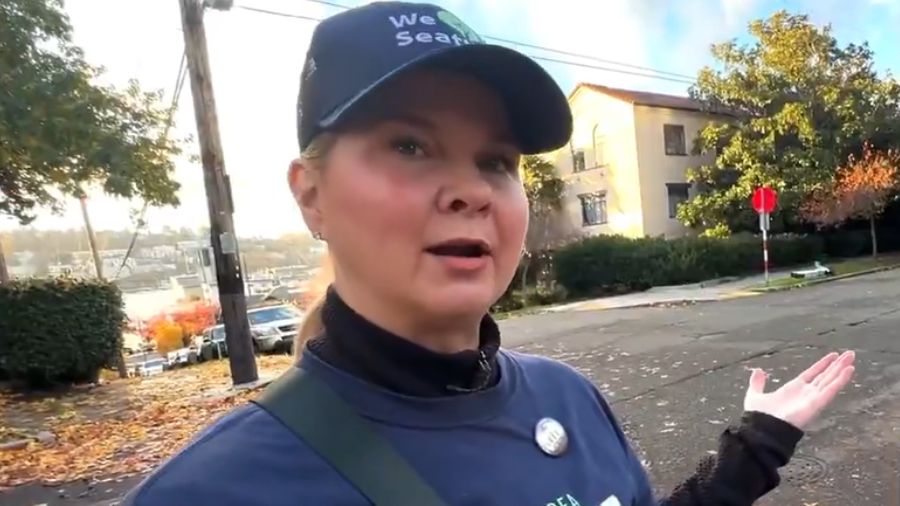
We Heart Seattle founder Andrea Suarez criticized the King County Council’s new sales tax for homeless children and families.(Photo courtesy of Andrea Suarez)
(Photo courtesy of Andrea Suarez)
The corner of First and Blanchard in Belltown was once a vibrant property listed for $3.8 million, but it has recently transformed into an abandoned hub for squatters, open drug use, and piles of stolen goods. Andrea Suarez, founder of the nonprofit We Heart Seattle, described the area as a failed experiment in permissive policing.
“I called it ‘Hamsterdam’ for those of you who watched ‘The Wire’ back in the 90s. It was a place where the police said, ‘Go there. If you’re using drugs and doing your business there, we’ll kind of leave you alone.’ That didn’t really work well here in downtown Seattle,” Suarez told The Jason Rantz Show on Seattle Red 770 AM.
How enforcement zones displaced the crisis to Belltown
The crisis at this specific Belltown corner appears to be an unintended consequence of the city’s “Stay Out of Drug Area” (SODA) zones. While these zones were designed to give police tools to clear drug activity from high-traffic parks, Suarez explained that “the unintended consequence is that somebody gets sandwiched” between these zones.
Blanchard Street became the “cutoff” where displaced individuals gathered, turning a residential block into an open-air drug market. Suarez noted that the area has shifted from a “beautiful jewelry store” to a “tobacco shop that sells methamphetamine pipes,” marking a steep decline for the community.
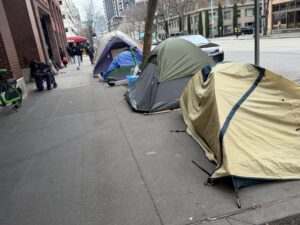
Frustrated by the “finger-pointing match between the landlord, the property management, and the city,” Suarez used social media to document a building she described as “a revolving door” filled with “broken plumbing, stolen goods, tents, and drugs.” Within 48 hours of her footage going viral, the city issued an emergency work ticket to board it up—a move Suarez says only happened because “people were becoming outraged” online.
The fear of political blowback
A central theme of the discussion was why elected officials seem hesitant to pivot from current policies despite visible failure. Suarez attributed this to a “fear of the blowback” from a vocal activist wing that she says uses intimidation to stall policy changes.
Suarez recounted a conversation with Council President Sarah Nelson, who reportedly admitted, “We are far from where we need to be because of the blowback.” Suarez noted that politicians are “fearful of people showing up at their door, doxing them, and picketing them.”
She criticized the current “ecosystem of social justice” for “kicking the butt of pragmatic, common-sense people,” adding that until leaders stop chasing the “progressive vote” out of fear, “blood is on their watch.”
A return to pragmatism
Looking forward, Suarez called for a “return to basics” regarding public safety and addiction, urging the new administration under Mayor Katie Wilson to move toward recovery-oriented programs. She argued that the city must stop “handing out foil and glass pipes” and instead focus on programs that “have an end goal of self-sufficiency.”
Suarez concluded that the “lenient, permissive, live-and-let-live” approach has led to avoidable tragedies. To turn the ship around, she stressed the need for a “good cop, bad cop” dynamic where the city provides help but also sets firm boundaries, similar to the “tough love” models used in family-first rehab.
“You love them, but you got to let them… you’ve got to, you know, kind of good cop, bad cop,” Suarez said. “We’ve just got to turn this ship around and go back to basics… we canceled accountability.”
Listen to The Jason Rantz Show on weekday afternoons from 3 p.m. – 7 p.m. on Seattle Red on 770 AM (HD Radio 97.3 FM HD-Channel 3). Subscribe to the podcast here. Follow Jason Rantz on X, Instagram, YouTube, and Facebook.
Related
 Rep. Baumgartner urges Gov. Ferguson to 'opt in' to new $1,700 federal education tax credit
 Unconstitutional income tax? Snohomish leader slams Bob Ferguson plan
 WA GOP slams Governor Bob Ferguson budget as smoke and mirrors on affordability
 Voters rethink Trump policies as economy and immigration numbers improve
 Seattle homeowners turn to barbed wire to protect from dangerous homeless encampments
 From Port Orchard to Walla Walla, 17 groups split $45 million for homeless veterans

Comments
3 Comments
1. The pockets of those who are friends or family of the elected officials are the ones being lined... so the money can filter back to the elected for their campaign coffers (so they can stay in power, "donate" money to the unions, all sorts of other shady stuff).
2. Who is going to investigate? Why, THEY investigated themselves, and they found that not only did they do nothing wrong, they deserve a HUGE pay increase.
3. See 2.
"...A central theme of the discussion was why elected officials seem hesitant to pivot from current policies despite visible failure..."
Seattle's elected officials cannot hamper with what is called the Homeless Industrial Complex. This man-made Homeless Industrial Complex is bringing in millions and millions of dollars into Seattle to END the homeless population crisis, cleanup Seattle's streets, make Seattle once again livable, safe.
All of those millions of dollars are useless due to NO MOTIVATION to END Seattle's homeless population crisis. Transparency of where those millions and millions are being spent is egregiously absent.
1. Whose pockets are being lined with the green that never makes it to the cause of ENDING Seattle's homeless population crisis?
2. Who is going to investigate why Seattle's homeless population crisis is increasing?
3. Who is going to investigate where all of the millions and millions of dollars have disappeared to because Seattle's homeless population made up of drug addicts, alcoholics, mentally ill, perpetual street people are still on the streets?
Doesn't there seem to be a problem with the Court House? The attorney General Nick Brown is more worried about Donald Trump than his own city's condition. He is definitely displayed his TDS, which seems to make people fanatical. The Democrats talk about Venezuela, and drug boats like somebody just hit their stash. Especially on every media channel that has Trump derangement syndrome also. When is Bonneville going to figure out that radio is a conservative-based audience. It's not a book with pictures, smoke mirror and light show. It's the cruise with no casino...
in Yakima 1986 it was called The HOLE, It's where the Mexican mafia distributed their cocaine. Did you know they ran the business out of a fake carpet store?