
Rantz: Everett should expand ‘no sit, no lie’ now—because sidewalks aren’t campsites
The Everett City Council is considering expanding a “no sit, no lie” rule


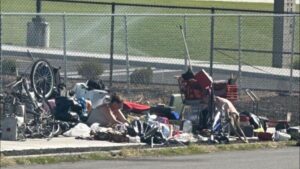
Everett is considering an expansion of a homeless encampment ban. (Photo: Jason Rantz, Seattle Red)
(Photo: Jason Rantz, Seattle Red)
Activists against Everett’s “no sit, no lie” ordinance love pretending this is about cruelty. That couldn’t be further from the truth.
The Everett City Council is considering expanding a “no sit, no lie” rule that would bar people from sitting, lying down, or camping on sidewalks in certain zones—around shelters, treatment centers, schools, libraries, and business corridors. The idea is to keep sidewalks clear and direct people toward services. Supporters say it protects public safety and access for businesses and disabled residents, while opponents argue it effectively criminalizes homelessness and just pushes people from block to block without adding enough shelter or treatment options.
The opponents are, as usual, completely wrong. Their policies keep the homeless on the streets where they suffer and will, inevitably, die. There’s a better solution.
Why would Everett give up sidewalks to the homeless?
Public sidewalks exist for the public—shoppers, commuters, seniors with walkers, parents with strollers, and disabled people who deserve ADA access without running an obstacle course of tents, trash, pipes, and needles. If the city can’t even promise a clear path to the front door of a business, it’s not compassionate; it’s incompetent.
We’ve tried the feelings-first approach. Years of slogans and “trauma-informed” paralysis didn’t reduce addiction or street disorder; they normalized it. So-called “harmed reduction” policies have kept homeless addicts addicted to fentanyl. But “No sit, no lie” creates predictable, enforceable boundaries in targeted areas—near shelters, treatment centers, libraries, schools, and small-business corridors. It says you can’t turn a sidewalk into a long-term living room or an open-air drug den. If services are offered, you take them. If laws are broken, there are consequences. That’s how civilization works.
Critics warn enforcement criminalizes poverty. Nonsense. It criminalizes behavior that destroys shared spaces and threatens public safety. Crimes are supposed to be criminalized. That’s how this works. It’s in the name.
No one is arrested for being poor. They’re cited for blocking rights-of-way, dealing or using drugs in public, or refusing to move from zones clearly designated for the common good. The status quo “compassion” traps people in the street, where overdose and victimization are routine. Real compassion is getting people off sidewalks and into sobriety, shelter, and treatment—and making the rules plain enough to enforce.
Communities are begging for relief
When storefronts board up, a neighborhood dies. City leaders owe more than moral posturing to taxpayers who fund services, police, sanitation, and outreach. They owe functional streets.
“No sit, no lie” also protects the very services activists claim to support. If you can’t keep sidewalks clear around a shelter or clinic, clients are deterred and staff are put at risk. Creating stable, predictable zones around these facilities makes it easier to deliver care, not harder. Add clear signage, consistent outreach, and a straight-line path into treatment, detox, and shelter—and then back those offers with enforceable rules. That’s the accountability-plus-help model that actually moves people off the street.
The usual scare line is that enforcement “doesn’t work.” Compared to what—tolerating overdose clusters and sidewalk encampments for years?
‘No sit, no lie’ is a tool in the toolbox
Enforcement is not a silver bullet. It’s a lever that only works when paired with services and a backbone. Cities that set clear rules, consistently apply them, and refuse to look the other way see fewer tents in commercial corridors and more follow-through into treatment. The alternative is the current loop: outreach without consequence, services without uptake, and neighborhoods hollowed out while politicians hold press conferences.
Expand “no sit, no lie.” Draw the zones. Post the signs. Staff the outreach. Fund detox and treatment beds. And empower police and code enforcement to do their jobs without the political second-guessing that’s paralyzed this region. Sidewalks are for the public. If we can’t even secure that baseline, we signal that nothing here is worth defending—not businesses, not families, not the people we claim to help. Order and compassion are not opposites. In a healthy city, they’re the same policy.
Listen to The Jason Rantz Show on weekday afternoons from 3 p.m. – 7 p.m. on Seattle Red on 770 AM (HD Radio 97.3 FM HD-Channel 3). Subscribe to the podcast here. Follow Jason Rantz on X, Instagram, YouTube, and Facebook.
Related
 We Heart Seattle launches new Shine the Emerald campaign, vows to tackle more homelessness
 Spokane Councilman Bingle blasts failed homeless law, demands return to voter mandate
 Tacoma moves to expand homeless camping ban to protect public spaces
 Rantz: Lynnwood scrapped cameras that track car thieves, now wants speed cameras ticketing drivers at 2 a.m. outside empty schools
 Rantz: The Education Lab takes Gates and Ballmer money, then prints activist talking points on trans athletes as fact
 Rantz: Under proposed WA bail rule, skipping court dates wouldn’t even count as proof you might skip court

Comments
1 Comments
Drove by the abandoned hotel next to the Everett Mall that the County bought for housing homeless indigents. Of course, it can’t be used because the tenants were cooking “meth” inside . . . so it just sits . . . is no one in charge? I would guess that the Democrats are in charge in Everett, am I wrong? Everett qualifies as a “Small Blue City”, similarly to the “Large Blue Cities” all run by Democrats. Everett means Snohomish County, too.